
Living Archives of Java Coffee: Tracing the Ancient Germplasm of Jolotigo–Tombo–Petungkriyono
admin
August 11, 2026
Knowledge Hub
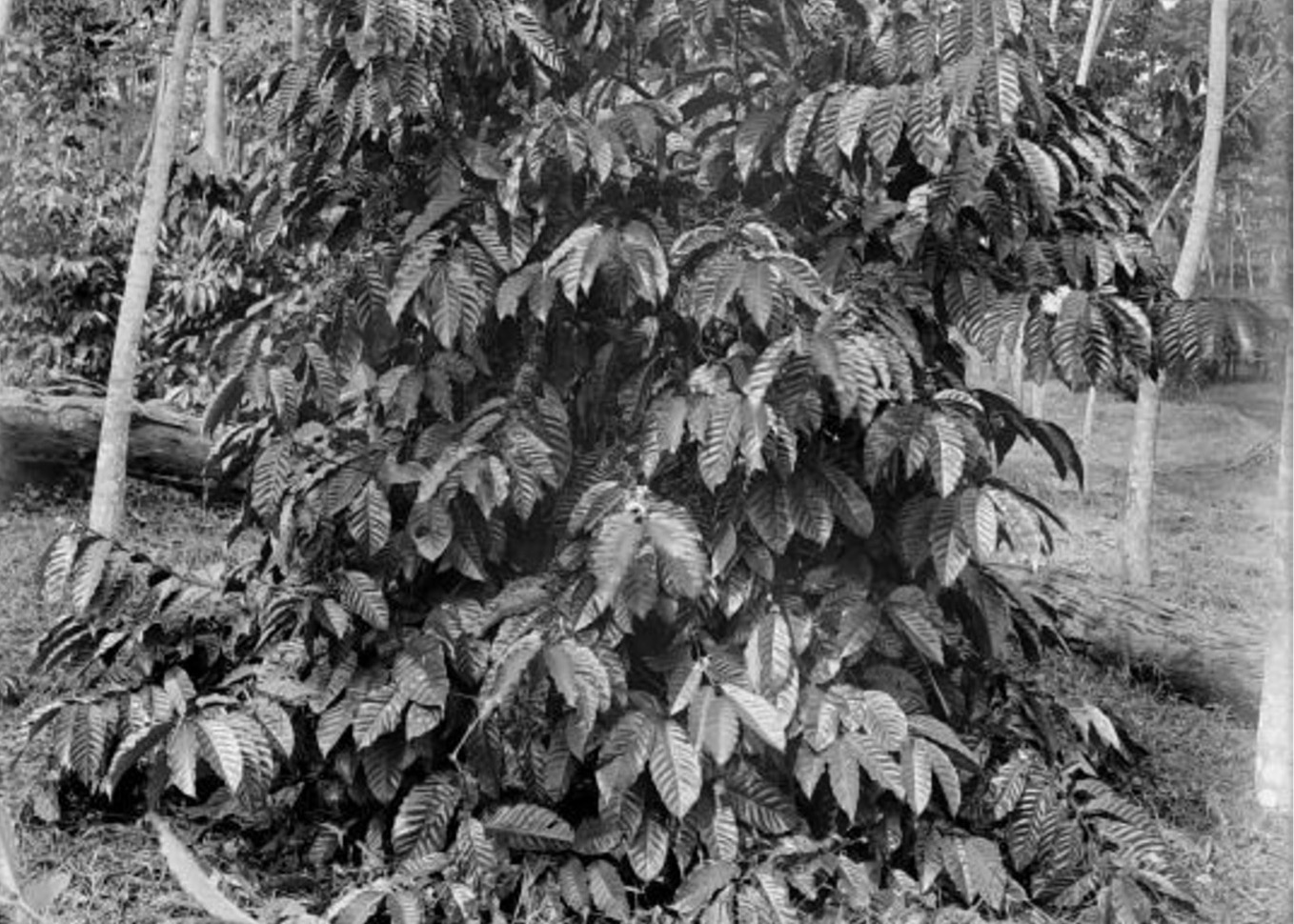
Coffee and cacao growing beneath kapok trees at Silowok Sawangan Plantation, Pekalongan, August 5, 1927. This photograph provides a glimpse into mixed-cropping systems and the use of shade trees in Java’s plantation landscapes during the colonial period. Photo: Collectie Wereldmuseum (formerly Tropenmuseum), National Museum of World Cultures, CC BY-SA 3.0.
On the mountain slopes separating Pekalongan and Batang Regencies, coffee is more than a plantation crop. It also carries stories. In Petungkriyono, several old Arabica trees are still known locally as “Javanese Arabica.” The trees are tall, with bronze-colored young leaves. Later, Caturra Arabica was introduced to the same area and, according to local accounts from Tlogohendro, its planting material came from the Tombo area in Batang Regency.
Robusta tells a different story. People in Tlogohendro recall that old Robusta planting material once came from lower-lying areas, including Kayupuring. In Kayupuring, local accounts further suggest that the source of the seeds was the Jolotigo plantation area. Around Jolotigo, old coffee plants locally identified as Robusta, Liberica, and Excelsa can still be found today. When these stories are considered alongside colonial plantation archives, coffee breeding literature, and the history of the surrounding landscape, an intriguing question emerges: Could the Pekalongan–Batang highlands still preserve a “living archive” of Java coffee’s long journey?
Jolotigo Began with Coffee
Today, Jolotigo is more closely associated with tea plantations. Yet the historical roots of the plantation are deeply connected to coffee.
Historical research by Fiona van Schendel shows that Djolotigo—the spelling used during the colonial period—was established as a coffee plantation company in 1875. The plantation subsequently faced various challenges involving production, management, prices, weather, and, most importantly, coffee leaf rust, which devastated Arabica plantations in Java toward the end of the nineteenth century. In 1898, Djolotigo changed ownership and was subsequently developed primarily as a tea and cinchona plantation.
However, the transition from coffee to tea did not necessarily mean that coffee immediately disappeared from Jolotigo.
An important clue appears in the 1915 Cultuuradresboek voor Nederlandsch-Indië. This colonial plantation directory still recorded Cultuurmaatschappij Djolotigo with the commodities: “Koffie, thee en kina”—coffee, tea, and cinchona.
This means that, at least until the second decade of the twentieth century, coffee was still recorded as part of Djolotigo’s production system. What remains unknown is which type of coffee. The 1915 document simply states koffie without specifying Arabica, Liberica, or Robusta. Therefore, the presence of coffee in Jolotigo during this period cannot be taken as direct evidence of Robusta. And this is precisely where the mystery begins.
A Plantation Whose Archives Have Yet to Be Fully Read
The historical traces of Djolotigo have not disappeared. The National Archives of the Netherlands in The Hague preserve the archive of Cultuurmaatschappij Djolotigo 1893–1959, under archival access code 2.20.37.12.
Its inventory is highly promising: it includes production reports from 1900–1907, managers’ correspondence books, correspondence between administrators and other plantation companies, annual reports from 1908–1957, cash reports, and documents concerning the history and operation of the plantation. Unfortunately, much of this material remains in physical form and is not yet fully available digitally.
Research by Pujo Semedi and Gerben Nooteboom on the history of labor at Jolotigo also directly draws on Jaarverslagen Cultuurmaatschappij Djolotigo and the archives of the Nederlandsche Handel-Maatschappij, which explicitly refer to the Koffieonderneming Djolotigo.
This research shows that after 1898, the company’s orientation increasingly shifted toward tea, with tea acreage expanding in the early twentieth century. Thus, the question is no longer whether Jolotigo ever had coffee—that is already clear.
The more interesting question is: When the old coffee plantations were being phased out, did Jolotigo ever receive new coffee types such as Liberica or Robusta?
When Robusta Began to Transform Java’s Coffee Plantations
This question becomes relevant because Jolotigo’s transformation coincided with a major shift in the history of coffee cultivation in Java.
After Arabica was severely affected by coffee leaf rust, plantations in the Dutch East Indies began searching for alternative planting materials. In the early twentieth century, Coffea canephora—later widely known as Robusta—entered plantation and research networks in Java. The Dutch East Indies subsequently became one of the earliest global centers for Robusta breeding.
Between 1907 and the 1930s, breeders in Java conducted mass selection, progeny testing, inbreeding experiments, grafting, and vegetative propagation. Several well-known series of planting materials eventually emerged from different research centers, including BP from Besuki/Kaliwining, SA from Sumber Asin, and Bgn from Bangelan.
However, not all Robusta that spread into smallholder farms during that period consisted of clones like those recognized today. Robusta is biologically highly heterozygous and predominantly cross-pollinating. Consequently, when propagated by seed, each generation produces genetic combinations that are not completely identical to those of the parent plant. This is important when interpreting old Robusta populations in Petungkriyono.
According to local accounts gathered during preliminary field investigations, old Robusta in this area was commonly propagated from seed, rather than through cuttings or grafts from a single clone. The plants tend to grow tall, with relatively flexible stems and beans that are smaller than those of some modern Robusta clones. Preliminary sensory assessments indicate that some exhibit predominantly chocolatey and spicy characteristics, medium body, and relatively low bitterness.
Because they have been generatively propagated over several generations, these materials are more appropriately regarded, for the time being, as an old Robusta population rather than as a single specific clone.
From Jolotigo to Kayupuring
Local oral histories provide clues about another pathway that is not always visible in company records. In Tlogohendro, people describe old Robusta as a crop that once received planting material from lower-lying areas, including Kayupuring. Meanwhile, accounts from Kayupuring connect the origin of this Robusta seed to Jolotigo.
If this information is eventually confirmed through interviews with multiple informants from different generations and families, a potential pathway for the dissemination of planting material may emerge:
Jolotigo → Kayupuring → other parts of Petungkriyono.
Such pathways would not necessarily appear in plantation administration records. Coffee fruit could have moved with plantation workers, relatives, traders, or farmers. A handful of ripe coffee cherries, later germinated in a home garden, could have been enough to establish a new coffee population. The seeds could then have been selected and replanted by subsequent generations.
Over several decades, material originally sourced from a plantation could therefore become a local coffee population shaped collectively by its original genetics, environment, and farmer selection.
Tombo and the Old Path Through the Forest
The story of Arabica in Petungkriyono appears to be different. For generations, people in Tlogohendro have known traditional routes crossing the forest toward Batang Regency, including Bandar and Tombo. These routes were still used until around the early 2000s for community mobility and the transportation of agricultural products, including spring onions. In such a landscape, administrative boundaries were never necessarily barriers to the exchange of planting materials.
According to oral histories from Tlogohendro, Caturra Arabica later introduced to the area originated from Tombo. Chronologically, this account is plausible. Caturra is a natural mutation of Bourbon first identified in Brazil around 1915–1918 and subsequently selected systematically from the late 1930s onward. It is characterized by a relatively short or compact growth habit and green young leaves.
This means that, if the identification of Tlogohendro’s Caturra is correct, the material clearly represents a younger layer of introduction than the old Arabica already known to the community.
Before Caturra, There Was “Javanese Arabica”
People in Tlogohendro recall that, before Caturra arrived, another Arabica type was already present and was locally referred to as Javanese Arabica. These old trees are described as tall and having bronze-colored young leaves.
This characteristic makes Typica one plausible candidate. World Coffee Research describes Typica as a tall Arabica variety with relatively large beans and bronze-colored young leaves. Typica also has a strong historical connection with Java.
However, the identification cannot stop there. There is also an Arabica variety internationally known as Java. Interestingly, Java is also tall, has large beans, and produces bronze-colored young leaves. Modern genetic studies summarized by World Coffee Research indicate that Java is not simply a Typica selection, as was once believed, but is related to an Ethiopian landrace that was introduced to Java.
Because of this morphological similarity, identifying the old Arabica in Tlogohendro as Typica solely on the basis of leaf color would be premature. For now, the safest approach is to retain the name used by the community: old Tlogohendro Javanese Arabica.
Its true identity can later be tested through standardized morphological characterization and, where possible, DNA fingerprinting.
Tombo Really Does Have a Coffee History
Tombo appears not only in oral histories. A colonial statistical record published in Economisch Weekblad in 1939 lists “Tombo incl. Wonodadi” under a statistical section explicitly titled “Koffie” for the Pekalongan region. The document indicates that coffee was still recorded as a plantation crop in the Tombo–Wonodadi area shortly before the end of Dutch colonial rule.
The National Archives of Indonesia also hold two specific files concerning N.V. Landbouw Onderneming Tombo en Wonodadi, covering 1929–1938 and 1939, respectively. These documents do not prove that Tombo coffee was Caturra—indeed, the Caturra known by local communities was probably introduced much later.
But the evidence confirms one important point: Tombo was indeed part of the historical coffee plantation landscape of the Pekalongan–Batang region. Given the traditional route between Tombo and Tlogohendro, the oral history concerning the movement of Arabica planting material becomes even more worthy of investigation.
Robusta, Liberica, and Excelsa: Another Layer of Jolotigo’s Coffee History
Equally intriguing is the presence of old plants locally identified as Liberica and Excelsa around Jolotigo, alongside Robusta. This information first needs to be botanically verified. Liberica and Excelsa can be difficult to distinguish in the field, and the taxonomic status of Excelsa itself is closely associated with the Liberica group.
Historically, however, the presence of Liberica in old plantation areas of Java would not be unusual. Liberica became known and was planted in Indonesia from the late nineteenth century, during a period when coffee plantations were searching for alternatives after Arabica was affected by coffee leaf rust.
If the plants currently found around Jolotigo are indeed old and their identities can be confirmed, they could provide clues to several waves of coffee introduction:
Old Arabica → Liberica → Robusta → later coffee materials.
However, the age of a tree must be distinguished from the age of its genetic lineage. A tree that is, for example, 50 or 70 years old is not necessarily a physical survivor from the colonial period. It may instead be a descendant of a much older planting. What may have been inherited is not the tree itself, but its germplasm.
From State Plantation to Smallholder Farms
Post-independence government archives also provide an important chronological boundary. Government Regulation of the Republic of Indonesia No. 163 of 1961 placed Jolotigo among state plantations with rubber and tea as its commodities. Coffee was not listed as an official commodity. In the same document, coffee was explicitly mentioned for other plantations where it was still being cultivated.
This indicates that by the early 1960s, coffee was no longer Jolotigo’s primary commodity administratively. But the absence of coffee from plantation records does not mean that every coffee tree disappeared from the landscape.
Plants can survive along block boundaries, in workers’ yards, on surrounding community land, in former plantations, or as mother trees from which local people obtain fruit and seeds. This is where company history and community history can diverge.
The plantation archives may have stopped recording coffee. But communities may have continued to grow it.
When Roads Become Genetic Corridors
The story of Jolotigo–Tombo–Petungkriyono shows that the history of plant varieties does not always move through research institutions and formal seed-distribution systems. Sometimes, it travels on foot.
The forest route connecting Tlogohendro and Tombo was not merely a path for transporting spring onions and other agricultural products. It may also have functioned as a corridor for the exchange of planting materials.
Likewise, the connection between Jolotigo, Kayupuring, and the upper parts of Petungkriyono may have facilitated the movement of seeds. Seeds traveled with people. Farmers selected trees that produced abundant fruit, survived well, tasted good, or simply had seeds readily available. Such selection took place without laboratories and without official variety names.
After several generations, something different from the original source plant could emerge: a local population with a history of its own.
This is why the search for old Robusta in Petungkriyono should perhaps not end with the question:
“Which BP clone is this?”
The more important questions are:
“Which gene pool does this population come from, how did it move, and which traits have survived after decades of growing in Petungkriyono?”
Robusta has a high level of heterozygosity and a predominantly cross-pollinating reproductive system. Consequently, populations repeatedly propagated through seed may retain considerable genetic variation. Modern research also emphasizes the importance of conserving C. canephora materials both in gene banks and on farmers’ fields, as local populations may contain individuals adapted to particular environments.
Coffee Trees as Living Archives
In historical research, archives usually consist of letters, reports, photographs, maps, or production figures. Yet in old agricultural landscapes, plants themselves can also function as archives.
Coffee trees cannot tell stories in words. But their canopy structure, leaf color, fruit and bean characteristics, flowering patterns, drought tolerance, disease resistance, bean size, and even flavor profiles can preserve information about their genetic lineage.
When such biological information is brought together with colonial archives + plantation history + historical maps + oral histories + traditional trade routes, we can begin to reconstruct a history that was previously hidden.
In this context, Jolotigo, Tombo, Kayupuring, and Tlogohendro are not merely four coffee-growing locations. Together, they may constitute a historical coffee germplasm landscape.
What Still Needs to Be Proven
This investigation remains at an early stage. There is currently no scientific basis for claiming that Petungkriyono Robusta is BP 42, BP 358, a particular SA clone, or another colonial-era clone. Likewise, the old Javanese Arabica of Tlogohendro cannot yet be confirmed as Typica or the Java variety.
Nor has it been established that the Liberica or Excelsa plants currently found around Jolotigo are direct descendants of colonial-era plantings.
It is precisely this uncertainty that makes further research important.
At least four steps are needed.
First, an inventory of old coffee trees in Jolotigo, Kayupuring, Tlogohendro, Tombo, and connecting locations. Second, systematic oral-history research, particularly with senior farmers, former plantation workers, and families known to have transported or propagated planting materials. Third, tree-level morphological and sensory characterization, rather than assessment only at the plantation level. And fourth, for selected key individuals, genetic analysis or DNA fingerprinting using reference materials for comparison.
Conserving Before It Is Lost
There is a reason this investigation should not remain merely a historical story. The modernization of coffee farms often involves replanting: old trees are removed and replaced with varieties considered more productive. From an economic perspective, such decisions can be entirely rational.
But without prior inventory, genetic material may be lost before its value is understood.
A Robusta tree producing relatively small beans may appear unremarkable if bean size is the only measure of success. Yet the same tree may possess tolerance to wet conditions, resistance to certain diseases, low bitterness, or adaptation to agroforestry systems that other materials do not possess.
Likewise, an old Arabica tree with bronze-colored young leaves may produce less than modern varieties while still preserving a genetic lineage of historical and breeding value.
Conservation does not mean that every old tree must be preserved forever. What is necessary is to identify them before replacing them.
An Archive That Has Yet to Be Fully Read
More than a century ago, plantation reports recorded coffee as tonnage, cultivated area, labor costs, and market prices. Today, those archives remain preserved in The Hague, Jakarta, old libraries, and various digital collections.
But another part of the same archive may still be growing on the slopes of Pekalongan and Batang.
It may exist in small-bean Robusta trees on community farms. In tall Arabica trees with bronze-colored young leaves. In Caturra that, according to farmers’ memories, arrived from beyond the forest in Tombo. In old Liberica and Excelsa trees around Jolotigo.
And in the memories of people who once walked across the mountains carrying agricultural produce—and perhaps, along the way, brought home a few coffee cherries or seedlings.
Perhaps what remains in Jolotigo, Tombo, and Petungkriyono is not merely a collection of old coffee trees.
Perhaps they are living archives of Java coffee’s journey—an archive that, to this day, we have only begun to read.
Note
This article is an initial investigation combining written historical sources with preliminary information and oral histories from communities in Petungkriyono and surrounding areas. The identities of the varieties and the genealogical relationships among the coffee populations discussed here remain working hypotheses and require further verification through historical documentation, morphological characterization, and genetic analysis.
References and Sources
- Arsip Nasional Republik Indonesia. Daftar Arsip Tekstual Departement van Binnenlandsch Bestuur, 1910–1942. Berkas No. 2836, Erfpachtsaanvraag van de N.V. Landbouw onderneming Tombo en Wonodadi, 1929–1938, dan No. 2839, tahun 1939.
- Bervoets, J.A.A. 1995. Inventaris van het archief van de Cultuurmaatschappij Djolotigo, 1893–1959. Nationaal Archief, Den Haag. Toegang 2.20.37.12.
- Cultuuradresboek voor Nederlandsch-Indië. 1915. Entri Cultuurmaatschappij Djolotigo: “Koffie, thee en kina.”
- Economisch Weekblad voor Nederlandsch-Indië. 2 Juni 1939. “Producties en Jaaroogstschattingen”, statistik Koffie, termasuk entri Tombo incl. Wonodadi untuk wilayah Pekalongan.
- Ferwerda, F.P. 1948. “Coffee Breeding in Java.” Economic Botany, 2: 258–272. Referensi dan pembahasan sejarah pemuliaan Robusta Jawa dirangkum kembali dalam tinjauan pemuliaan Robusta terkini.
- Pemerintah Republik Indonesia. 1961. Peraturan Pemerintah Republik Indonesia Nomor 163 Tahun 1961 tentang Pendirian Perusahaan Perkebunan Negara Kesatuan Jawa Tengah IV. Entri Jolotigo mencantumkan perkebunan karet dan teh.
- Semedi, Pujo. 2018. “Vanishing Frontiers: A Javanese Plantation Emplacement, 1870s–2000s.” Humaniora, 30. Universitas Gadjah Mada.
- Semedi, Pujo & Gerben Nooteboom. 2018. “The Development and Demise of Child Labour in a Javanese Tea Plantation, 1900–2010.” Humaniora, 30(3). Artikel ini menggunakan sejumlah arsip primer Cultuurmaatschappij Djolotigo dan Nederlandsche Handel-Maatschappij.
- Van Schendel, Fiona. 2000. Djolotigo: Ontginning en exploitatie van een particuliere koffie-onderneming op Java, 1875–1898. Amsterdam: Nederlandsch Economisch-Historisch Archief.
- World Coffee Research. Typica. Arabica Varieties Catalog. Typica dideskripsikan sebagai varietas bertajuk tinggi dengan pucuk daun bronze.
- World Coffee Research. Java. Arabica Varieties Catalog. WCR mengklasifikasikan Java sebagai material Ethiopian landrace yang memiliki sejarah introduksi di Jawa dan karakter tanaman tinggi dengan pucuk bronze.
- World Coffee Research. Caturra. Arabica Varieties Catalog. Caturra merupakan mutasi Bourbon bertajuk kompak yang ditemukan di Brasil sekitar 1915–1918.
- Sseremba, G., dkk. 2025. “Genetic improvement of robusta coffee (Coffea canephora) in the 20th and 21st centuries: prospects for increasing future breeding effectiveness and impact.” Frontiers in Plant Science. Membahas sejarah awal pemuliaan Robusta di Hindia Belanda, material BP–SA–Bgn, reproduksi silang Robusta, dan konservasi germplasm.
- BRMP Perkebunan, Kementerian Pertanian RI. 2025. “Liberika dan Excelsa: Jejak Eksotisme Kopi Nusantara.”
Contributor:
Meiardhy Mujianto
“Dynamic Harmony between Human and Nature.”
-Relung Indonesia
Tags :
Knowledge Hub
Share This :
Category
- Ecosystem Restoration
- Biodiversity and Wildlife Conservation
- Community Ecological Education
- Digital Climate Action
- Climate Movement
- Knowledge Hub
- Sustainable Biodiversity-Based business
- Bioconversion and Bioprocessing-Based Business (4B)
- Sustainable Community-Based Tourism (SCBT)
- Integrated Agroforestry Initiatives
- Carbon Farming Initiative
- Basic service access and quality improvement for communities
- Livelihood Improvement Interventions
- Development of Social Networks and Cooperation
- Participatory Sustainable Livelihood Assesment
- Women's Empowerment Collective
- News
Upcoming Events
Discussion: Disability and Social Inclusion
28
March
- Sleman, Yogyakarta
- 15.00 PM - 18.30 PM
Improving Facilitation Skills: Effective Techniques and Strategies
04
June
- Sleman, Yogyakarta
- 14.00 PM - 17.00 PM
Other Pages
Contact Info
- Omah Relung. Kalipentung RT03/RW17 Kalitirto Berbah Sleman Yogyakarta 55573.
- +62 851-7544-2708
- info@relung.or.id
Newsletter
Take care of the environment with Relung Indonesia Foundation! Get the latest information about forestry and the environment in Indonesia.
Relung Indonesia Foundation
Copyright © 2023. All rights reserved.