
A SCHOOL AT THE EDGE OF THE MOUNTAINS
admin
September 1, 2026
Knowledge Hub
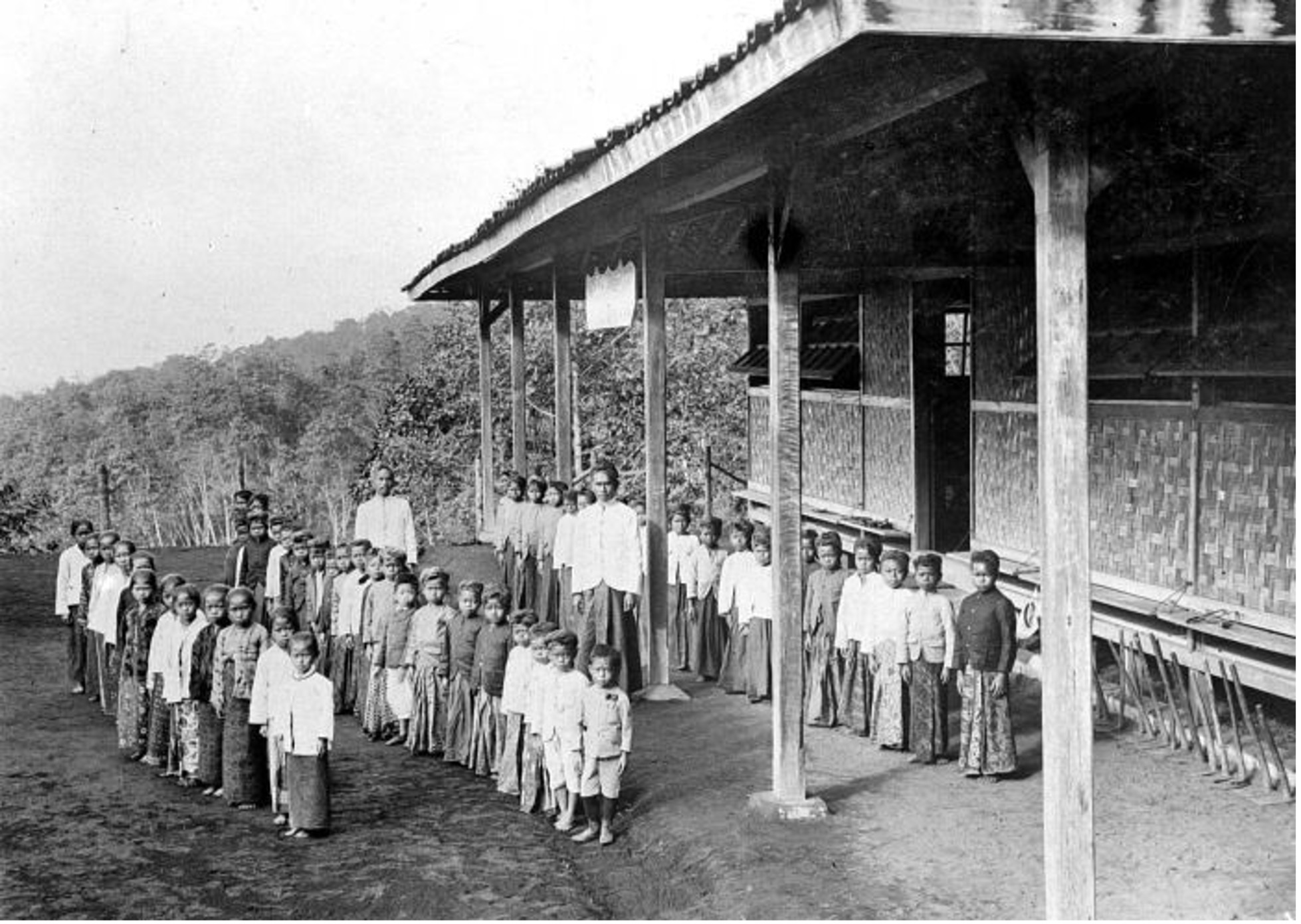
Petungkriyono, Ethical Policy, and the Cost of Education Reaching the Village
A village school (Desaschool) at the government cinchona plantation of Tjinjiroean, Priangan, West Java, circa 1920. The village school system developed from 1907 onward became one of the ways the colonial government expanded basic education at relatively low cost and with the involvement of local community resources. Source: Collectie Wereldmuseum (formerly Tropenmuseum), object no. 10002285.
In late December 1906, heavy rain accompanied by strong winds swept through the mountainous region south of Pekalongan. Reports published several weeks later recorded damage in a number of places. Among the buildings mentioned was something small, yet highly significant for the history of Petungkriyono: “de inl. school”—the indigenous school—in the onderdistrict Petoengkriono.
The Bataviaasch Nieuwsblad of 15 January 1907 reported that rain on 26–28 December 1906, accompanied by strong winds, had damaged the indigenous school in Petoengkriono, Afdeeling Pekalongan. That brief sentence carries considerable historical significance. It proves that by the end of 1906, when Petungkriyono was still a mountainous area far from the center of Pekalongan, a formal colonial school—or at least a school recognized by the colonial administration as an inlandsche school—was already operating there. More interestingly, the school existed before the Dutch East Indies government broadly introduced the desaschool or volksschool system in 1907.
Thus, the history of schooling in Petungkriyono does not appear to have begun as a direct consequence of Van Heutsz’s Village School program. It may instead have emerged within a slightly earlier wave: the expansion of indigenous education during the first years of the Ethical Policy. And this is where a small school in the mountains of Pekalongan intersects with a much larger debate about the future of the Dutch East Indies.
A “Debt of Honor”
By the end of the nineteenth century, an increasing number of Dutch people had begun questioning the moral foundations of their own colonialism. For decades, the Indies had generated enormous profits for the Netherlands. The Cultivation System and what later became known as the batig slot had allowed part of the Indies’ financial surplus to flow into the royal treasury in Europe. As the economic conditions of the indigenous population deteriorated toward the end of the nineteenth century, it became increasingly difficult to maintain the idea that the colony could simply be treated as a source of revenue.
One of the most influential criticisms came from Conrad Theodor van Deventer. In his famous article, “Een Eereschuld,” published in De Gids in August 1899, Van Deventer argued that the Netherlands owed an “honorary debt” to the Indies. He calculated that hundreds of millions of guilders had flowed from the Indies to the Netherlands and argued that some of that wealth should be returned in the form of development for the inhabitants of the colony.
This was not merely a debate about money. What was changing was the moral language of colonialism. A state that throughout much of the nineteenth century had spoken largely in terms of profit was beginning to speak in terms of responsibility.
Van Deventer was not alone. In Semarang, journalist Pieter Brooshooft, who had long served as editor of De Locomotief, also helped shape changing public opinion. In his 1901 pamphlet De ethische koers in de koloniale politiek, Brooshooft described poverty and various forms of exploitation suffered by the indigenous population and called for a change in the direction of colonial policy. A debate that had previously taken place mainly in newspapers, magazines, and intellectual circles eventually entered the official language of the state.
In the 17 September 1901 Speech from the Throne, the Dutch government declared that the Netherlands had a “zedelijke roeping”—a moral calling or obligation—toward the inhabitants of the Indies. This statement is commonly regarded as one of the formal milestones in the emergence of the Ethical Policy.
Education as a Path toward “Progress”
In popular memory, the Ethical Policy is often reduced to three words: irrigation, emigration, education. In reality, it was far more complicated. The Ethical Policy was not a single package implemented all at once. It was a collection of policies, debates, and experiments that developed over many years, with objectives that did not always coincide even among its supporters.
There was a humanitarian element to it. But there were also economic needs, administrative interests, and a desire to preserve colonial power. Historian E.H. Kossmann even emphasized that the Ethical Policy developed alongside the strengthening of Dutch power across the Indonesian archipelago. Under Van Heutsz, the expansion of colonial authority and programs of “development” were not two opposing forces; they were both part of the same colonial project of governance.
Education nevertheless became one of the most visible expressions of this change. Around 1900, educational opportunities for the indigenous population remained extremely limited. Existing government schools were too expensive to expand to every village. A shortage of teachers was also a serious problem. Kossmann noted that the government quickly confronted a simple but decisive problem: mass education required money and teachers on a scale that was not available.
In the Residentie Pekalongan itself, our examination of statistical records shows that the network of indigenous schools began to expand rapidly in the early twentieth century. Alongside government schools, there were also considerable numbers of particuliere scholen—schools that were not entirely run by the government.
It was against this backdrop that the existence of a school in Petoengkriono becomes particularly interesting. Petoengkriono had already appeared in the colonial administration at least by the late nineteenth century. Yet the area was located deep in the mountains, far from educational centers such as Pekalongan, Wiradesa, and Kedungwuni.
If an inlandsche school was already operating there by the end of 1906, this means that the expansion of education during the early Ethical Policy had already reached a peripheral region before the 1907 Village School program assumed its mass form.
The Petungkriyono School Predated the Volkschool
This matters because chronology can easily mislead us. Governor-General J.B. van Heutsz, who governed from 1904 to 1909, was closely associated with the emergence of the desaschool. In 1907, the government began systematically developing simple village schools with a three-year course of study. Kossmann described them as schools organized by village communities.
Yet the Petungkriyono school had already been mentioned in a report concerning December 1906. This means that the Petungkriyono school we have identified cannot simply be called a Van Heutsz Volkschool. It may later have been reclassified. It may have been renovated and incorporated into the new system. It may also have been a private school or another type of indigenous school that had already emerged during an earlier wave of educational expansion.
We do not yet have archival evidence that can answer this question. That uncertainty is precisely what makes its history interesting. Petungkriyono may provide an example of how the expansion of education in the early twentieth century did not always follow a single decision from Batavia in a uniform manner. Government schools, private schools, initiatives by local officials, community initiatives, and later mass programs may have overlapped with one another.
Why Did Van Heutsz Need Cheap Schools?
The problem was cost. The indigenous second-class schools previously used by the government were still too expensive to become a form of universal education. A contemporary article from 1917 explained that if this more expensive educational model were expanded into general popular education, the budgetary requirements would be enormous.
That was why, from 1907 onward, extremely simple village or gemeente schools began to emerge. Here lies one of the great paradoxes of the Ethical Policy. The Dutch declared that they had a moral obligation to educate the people of the Indies. Yet the colonial state was unwilling—and in practice unable—to bear the entire cost of mass education.
The solution was to create schools that were cheap. Their curriculum was simple. The period of study was short. Teachers were less expensive. And much of the burden of running the schools was placed on the village community. A 1917 issue of Neerlandia explains this quite explicitly: desascholen were established and “grootendeels … bekostigd door de plaatselijke gemeenschappen”—largely financed by local communities—including through the collection of school fees. At the initial stage, the government provided financial assistance.
The result was extraordinarily inexpensive for the state. The same source estimated that popular education through desaschool at the time cost the government treasury less than three guilders per child per year, excluding inspection and administrative costs. The system of mass education had found its formula: the state designed the system, but the village helped pay for its operation.
Who Actually Built the School?
This is where we need to be careful with terminology. There is insufficient evidence to claim that there was a single universal regulation stating that the central government was, under all circumstances, prohibited from financing the construction of village school buildings. The sources instead indicate that funding patterns could vary and that government assistance was provided during the early stages.
The general principle, however, is clear: the desaschool was designed as an institution rooted in the capacity of the local community, rather than as a school whose entire construction and operating costs were borne by Batavia. Land, building materials, labor, maintenance, school fees, community funds, or other forms of local contribution could therefore play an important role. This is where the term dorpskas, or village fund, becomes relevant.
There is another important qualification. We also do not yet have specific evidence from Petungkriyono showing that its school building was constructed through heerendiensten—colonial compulsory labor—in the formal legal sense. It is therefore safer to distinguish between colonial compulsory labor (heerendienst) and community labor, village work, self-help, or communal obligations. The two may appear similar from the outside, but historically they were not necessarily the same legal category.
For Petungkriyono, until archival evidence concerning the construction of the school is discovered, the safest formulation is this: it is highly likely that the construction and maintenance of the school involved local community resources, whether money, materials, or labor, in accordance with the general logic of the colonial village-school system; but the precise form of those contributions remains unknown. This is the boundary between a plausible reconstruction and an archival fact.
Imagine What It Meant for a Mountain Village
In government centers, the question of education could be written as a budget table. In Petungkriyono, the question took a very different form. Opening a school meant finding a piece of land. Timber had to be obtained. Bamboo or roofing materials had to be provided. The building had to be constructed and later maintained. A teacher had to live in or travel to an area with difficult access.
All of this took place in a society whose economy was still largely based on agricultural production and local exchange. A school was therefore not merely an educational policy. It was a social investment by the village.
If future archival research shows that the people of Petoengkriono provided land, timber, bamboo, or labor for their school, we will no longer have only a history of “the Dutch establishing a school.” We will have a far more complex history:
the colonial state opened an educational space, but part of the material cost of that modernization was borne by the very community that was supposed to be modernized.
That is a dimension of the Ethical Policy rarely visible in its slogans.
Ethical, Yet Still Colonial
The word ethical can sometimes make these policies sound too benevolent. It is true that educational opportunities expanded. The number of indigenous children attending school increased sharply during the early twentieth century. A 1917 report recorded an increase in the number of children receiving elementary education from approximately 128,000 in 1900 to more than 600,000 in 1914.
Yet access remained highly unequal.
The colonial education system differentiated schools according to social status, race, and administrative purpose. High-quality education and the use of the Dutch language remained far more accessible to elites than to the majority of the rural population. The government itself was concerned about the social consequences of spreading Western education too widely.
The Ethical Policy should therefore not be read as a simple story of colonialism suddenly becoming benevolent. It represented a change in the way colonialism operated. Exploitation did not disappear. Colonial power actually became stronger.
At the same time, schools, health services, credit systems, irrigation, and various forms of developmental intervention emerged. Education became both a means of “advancing” the population and an instrument for shaping a society that could be more easily administered by the colonial state. It is this paradox that makes a small school in Petungkriyono so historically compelling.
Petungkriyono Stood at the Boundary Between Two Eras
In 1899, Van Deventer wrote about the eereschuld. In 1901, the Dutch monarchy acknowledged a zedelijke roeping. In the following years, the network of indigenous education expanded. In December 1906, a school was already operating in Petoengkriono. Then, in 1907, the Van Heutsz government developed the desaschool as an answer to the problem of how education could reach large numbers of villages without causing the colonial budget to explode. The simple, inexpensive three-year schools, which relied heavily on local communities, subsequently expanded rapidly.
With this chronology in mind, the Petungkriyono school appears to have stood precisely at the boundary between two phases in the history of colonial education: the first phase, the early expansion of indigenous education within the atmosphere of the Ethical Policy; and the second phase, the massification of education through the village-school system beginning in 1907. This is far more interesting than simply saying: “The Dutch built a school in Petungkriyono because of the Ethical Policy.”
So Where Was the School?
This is the mystery that remains unresolved. Local information points to Mudal, Yosorejo Village, as the location of the earliest school in the Petungkriyono area. To date, however, no colonial archive has been found that explicitly connects: Petoengkriono → school → Moedal/Josoredjo.
Mudal must therefore continue to be treated as a highly important hypothesis for the school’s location, rather than as an established fact. But if this connection is eventually proven, its significance will be considerable. Mudal would not merely be the place where an old school once stood. It could become the material point at which a major idea born from political debates in Amsterdam, The Hague, Batavia, and Semarang finally reached a mountain community in Petungkriyono.
From Van Deventer’s article in De Gids, Brooshooft’s criticism through De Locomotief, the royal speech of 1901, colonial educational policy, decisions by officials in Pekalongan, and finally—a school building in Petungkriyono. And at the end of December 1906, when wind and rain damaged that building, a colonial official recorded it. A single small line in a newspaper more than a century ago tells us that ideas about education, power, moral debt, and colonial modernization had already reached the mountains of Petungkriyono.
The School as a Grassroots Trace of the Ethical Policy
Perhaps this is the best way to read the history of the Petungkriyono school. Not merely by asking: “Who established it?” But also: Who provided the land? Who brought the timber? Who built its walls and roof? Who paid the teacher? Which villages did the children walk from each morning to attend school? And what changed after they began learning to read, write, and count?
The Ethical Policy emerged from a debate about the moral obligations of a colonial state. But in the villages, that policy took concrete form through buildings, teachers, local funds, community labor, and children sitting in classrooms. The history of the Petungkriyono school is therefore not a peripheral footnote. Instead, it offers a small window into one of the great paradoxes of early twentieth-century colonialism:
The Dutch began to claim that they had an obligation to educate the people of the colony; yet to realize mass education, the colonial state created a system in which village communities were also required to bear part of the cost.
And perhaps, somewhere in Mudal or elsewhere in Petoengkriono, the material traces of that process once stood. We simply have not yet found their name in the archives.
Literatur dan Sumber Utama
- C.Th. van Deventer, “Een Eereschuld,” De Gids 63, 1899. Artikel yang menjadi salah satu teks paling berpengaruh dalam lahirnya wacana Politik Etis.
- Pieter Brooshooft, De ethische koers in de koloniale politiek, Amsterdam: De Bussy, 1901. Penting untuk melihat kritik sosial dan wacana publik kolonial menjelang peresmian Politik Etis.
- Troonrede, 17 September 1901. Memuat formulasi pemerintah Belanda mengenai zedelijke roeping terhadap penduduk Hindia. Teks dan konteks dibahas oleh Kees Groeneboer.
- Bataviaasch Nieuwsblad, 15 Januari 1907, hlm. 1. Sumber primer terpenting sejauh ini mengenai keberadaan inlandsche school di Petoengkriono pada Desember 1906.
- “Oost-Indië,” Neerlandia, jrg. 21, 1917. Sangat penting untuk memahami struktur pembiayaan desascholen: sekolah didirikan dan sebagian besar dibiayai komunitas lokal, sementara pemerintah memberi bantuan awal.
- S.L. van der Wal (ed.), Het onderwijsbeleid in Nederlands-Indië 1900–1940: Een bronnenpublikatie, Groningen: J.B. Wolters, 1963. Merupakan publikasi sumber fundamental mengenai kebijakan pendidikan kolonial awal abad ke-20.
- E.H. Kossmann, De Lage Landen 1780–1980, bagian mengenai politik kolonial Belanda. Berguna untuk menempatkan pendidikan, Van Heutsz dan desaschool dalam konteks Politik Etis sekaligus imperialisme kolonial.
- Kees Groeneboer, Weg tot het Westen: Het Nederlands voor Indië 1600–1950, 1993. Sangat berguna untuk memahami hubungan Politik Etis, pendidikan, bahasa dan konsep “opvoeding tot autonomie”.
- E.B. Locher-Scholten, Ethiek in fragmenten: Vijf studies over koloniaal denken en doen van Nederlanders in de Indonesische Archipel 1877–1942, Utrecht, 1981. Kerangka penting untuk membaca Politik Etis bukan hanya sebagai kebijakan kesejahteraan, tetapi juga sebagai bagian dari konsolidasi kekuasaan kolonial.
Contributor:
Meiardhy Mujianto
“Dynamic Harmony between Human and Nature.”
-Relung Indonesia
Tags :
Knowledge Hub
Share This :
Category
- Ecosystem Restoration
- Biodiversity and Wildlife Conservation
- Community Ecological Education
- Digital Climate Action
- Climate Movement
- Knowledge Hub
- Sustainable Biodiversity-Based business
- Bioconversion and Bioprocessing-Based Business (4B)
- Sustainable Community-Based Tourism (SCBT)
- Integrated Agroforestry Initiatives
- Carbon Farming Initiative
- Basic service access and quality improvement for communities
- Livelihood Improvement Interventions
- Development of Social Networks and Cooperation
- Participatory Sustainable Livelihood Assesment
- Women's Empowerment Collective
- News
Upcoming Events
Discussion: Disability and Social Inclusion
28
March
- Sleman, Yogyakarta
- 15.00 PM - 18.30 PM
Improving Facilitation Skills: Effective Techniques and Strategies
04
June
- Sleman, Yogyakarta
- 14.00 PM - 17.00 PM
Other Pages
Contact Info
- Omah Relung. Kalipentung RT03/RW17 Kalitirto Berbah Sleman Yogyakarta 55573.
- +62 851-7544-2708
- info@relung.or.id
Newsletter
Take care of the environment with Relung Indonesia Foundation! Get the latest information about forestry and the environment in Indonesia.
Relung Indonesia Foundation
Copyright © 2023. All rights reserved.