
Calon Arang: A Myth of a Society That Undermines Its Own Balance
admin
April 15, 2026
Knowledge Hub
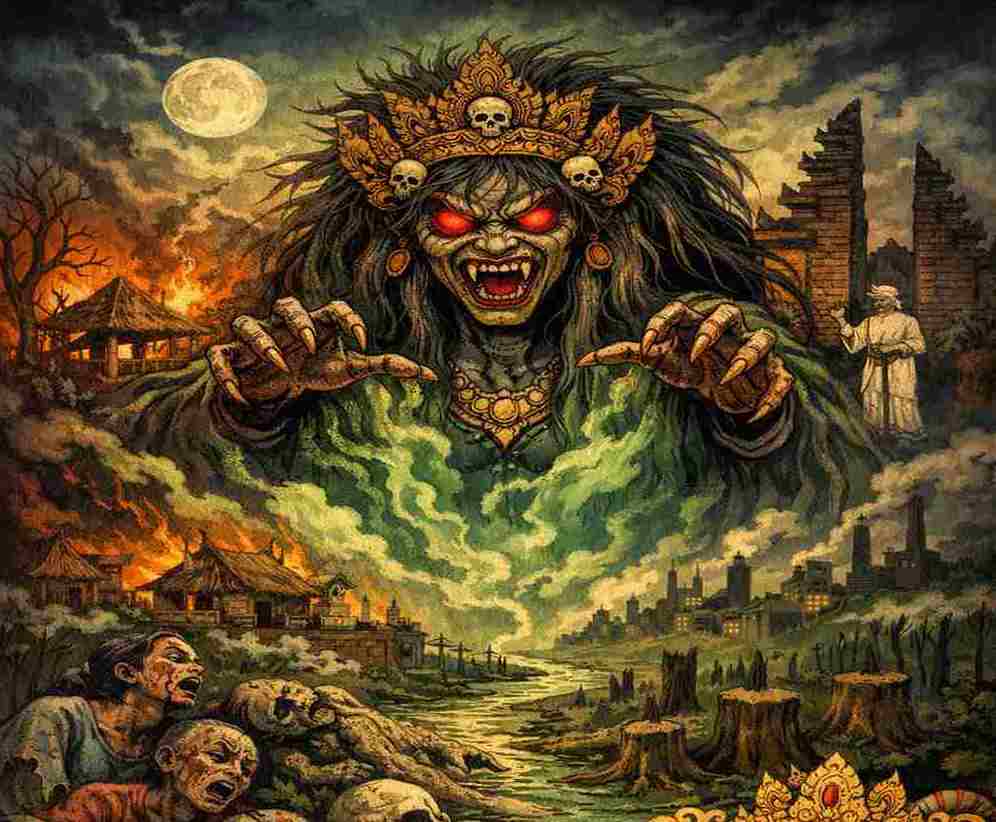
Calon Arang
For too long, Calon Arang has been reduced to a simple moral tale: a dangerous woman unleashes chaos, a plague spreads, and a holy figure restores order. This reading is comfortable—but deeply reductive. It flattens a complex myth into a binary drama of evil to be eliminated. Read more carefully, however, Calon Arang emerges not as a story about sorcery alone, but as a narrative of a society that fails to manage its own tensions—until those tensions erupt into plague, fear, and the breakdown of shared life.
Across many accounts, the true terror of Calon Arang lies not in individual deaths, but in the spread of pageblug—an epidemic that paralyzes Kahuripan. This matters because a plague always exceeds any single perpetrator. It marks a shift from the personal to the collective, from private wounds to the social body. In this sense, Calon Arang is best understood as a myth of systemic crisis: when resentment, stigma, fear, and spiritual power converge, what collapses is not just individual lives, but the very metabolism of communal existence.¹²
At this point, an ecological reading becomes crucial. Not because the text speaks in modern environmental terms, but because it operates within a more radical logic: humans, disease, space, death, and the cosmos are inseparable. Within this framework, social crises do not remain confined to human relations; they spill into the order of the world itself. When pageblug erupts, it signals not merely mystical punishment, but a rupture in the balance between society and the broader fabric of life.
This is why the story is deeply embedded in liminal spaces: cremation grounds (pasetran), graves, night, ritual, and the threshold between the living and the dead. These are not ornamental elements of horror. They are sites where societies articulate anxieties about order itself. Accounts of Calonarang in Balinese culture describe rituals performed in the Gondomayit cremation ground, explicitly invoking Durga to unleash plague.⁴ Here, “nature” is not a passive backdrop but an active field where social crisis takes on cosmic form. What is disrupted is not only political order, but the very way a community inhabits its sacred landscape.
It is also a mistake to read Calon Arang simply as a story of a “female monster.” Such a reading is intellectually shallow. The figure instead functions as a repository for collective fears: of widows, of knowledgeable women, of power beyond the court, of forces resistant to formal control. Yet myths do something more unsettling than producing scapegoats—they conceal collective failure within a single figure. In this sense, Calon Arang feels strikingly contemporary. Societies still reduce structural crises to individual blame, as if eliminating one figure could restore order. The myth itself suggests otherwise: a catastrophe of this scale is only possible when the social order is already fragile.⁵
The figure of Rangda is central here. Contemporary scholarship shows that Rangda cannot be reduced to a symbol of evil. She embodies a dual force—destructive and protective—aligned with the concept of rwa bhineda, the dynamic tension between opposing forces that sustains cosmic balance.³⁶ If so, the message of Calon Arang becomes more unsettling: the world is not restored by eradicating darkness, because darkness is intrinsic to the cosmos. What must be restored is not the absence of conflict, but its balance. The problem is not the existence of destructive forces, but the failure to contain and regulate them—until they erupt as catastrophe.
This makes Calon Arang more than folklore. It challenges the modern illusion that humans stand outside nature, capable of controlling it from a distance. Instead, it presents an entangled world: ritual, body, disease, landscape, power, fear, and the divine are inseparable. Social rupture inevitably takes ecological form. In this sense, plague becomes a language—a way of expressing that something fundamental has gone wrong in the order of life. Studies of Barong–Rangda reinforce this view, framing myth as an ethical and ecological system that binds humans, nature, and the sacred in an ongoing negotiation of balance.³⁷
What makes Calon Arang enduringly relevant is that we continue to generate new forms of pageblug. We call them ecological crises, public health emergencies, social fragmentation, or crises of trust. The pattern, however, remains unchanged: neglected imbalances eventually erupt into collective disaster. We overexploit, tolerate inequality, ignore social wounds—and then act surprised when instability follows. In this light, Calon Arang is not an outdated myth, but a warning: a society that fails to maintain balance will ultimately inhabit a world shaped by its own fears.⁸
Reading Calon Arang as a myth of ecological and social crisis is therefore not an imposition of modern concerns onto an ancient text. It is the opposite: allowing the myth to illuminate realities we still face. It reveals that disaster is never purely natural or purely social, but always both. It reminds us that shared life deteriorates not only through external shocks, but through accumulated resentment, stigma, inequality, and moral neglect. And most provocatively, it suggests that what we call a “monster” is often nothing more than a name we give to crises of our own making.⁹
Footnotes
- Calonarang dalam Kebudayaan Bali explains in detail the spread of pageblug (plague) by Calon Arang in Kahuripan and positions it as the central narrative conflict. See I Ketut Ardhana et al., Calonarang dalam Kebudayaan Bali (Denpasar: Pustaka Larasan/Udayana University Press, 2015), particularly the section on the plague in Kahuripan.
- The article “The Epidemic, Mysticism, and Traditional Beliefs in Old Indonesian Literature” identifies Calon Arang as one of the classical texts containing discourse on epidemics/pandemics, making it relevant to read as a narrative of disease, not merely individual sorcery.
- Studies on Barong–Rangda and the symbolism of Rangda emphasize that, in Balinese cosmology, conflict is understood within a framework of cosmic balance rather than binary moral opposition. See “The Meaning of the Rangda Symbol” and “Barong and Rangda as Cultural Symbols.”
- In Ardhana et al., the Calon Arang ritual is described as taking place in the Gondomayit cremation ground and is associated with invoking Durga to bring about plague. This reinforces the interpretation that sacred-liminal landscapes are integral to the myth, not merely dramatic elements.
- This reading is a critical inference from the narrative structure and studies of epidemics in classical literature: while the figure of Calon Arang is central, the impact is always collective. Thus, the story is productively read as a myth about the fragility of social order rather than the deviation of a single individual.
- “The Meaning of the Rangda Symbol” concludes that Rangda is not merely a symbol of evil power, but also a sacred entity that plays a role in maintaining cosmic order through the duality of destructive–protective forces and the concept of rwa bhineda.
- “Barong and Rangda as Cultural Symbols: Dualism, Conservation, and Social Harmony” explicitly describes myth as a source of ecological, ethical, and spiritual wisdom that connects humans, nature, and the divine.
- This contemporary relevance is an analogical reading, not a historical claim. It is based on findings that Calon Arang is understood in modern scholarship as a narrative of pageblug, while the Barong–Rangda myth is read as an ethical-ecological framework for social and cosmic balance.
- This concluding statement is an interpretive thesis: it synthesizes findings on pageblug, Rangda’s duality, and cosmological balance into a critique of the tendency to attribute complex crises to a single figure, when in fact they are structural in nature.
Contributor:
Meiardhy Mujianto
“Dynamic Harmony between Human and Nature.”
-Relung Indonesia
Tags :
Knowledge Hub
Share This :
Category
- Ecosystem Restoration
- Biodiversity and Wildlife Conservation
- Community Ecological Education
- Digital Climate Action
- Climate Movement
- Knowledge Hub
- Sustainable Biodiversity-Based business
- Bioconversion and Bioprocessing-Based Business (4B)
- Sustainable Community-Based Tourism (SCBT)
- Integrated Agroforestry Initiatives
- Carbon Farming Initiative
- Basic service access and quality improvement for communities
- Livelihood Improvement Interventions
- Development of Social Networks and Cooperation
- Participatory Sustainable Livelihood Assesment
- Women's Empowerment Collective
Upcoming Events
Discussion: Disability and Social Inclusion
28
March
- Sleman, Yogyakarta
- 15.00 PM - 18.30 PM
Improving Facilitation Skills: Effective Techniques and Strategies
04
June
- Sleman, Yogyakarta
- 14.00 PM - 17.00 PM
Other Pages
Contact Info
- Omah Relung. Kalipentung RT03/RW17 Kalitirto Berbah Sleman Yogyakarta 55573.
- +62 851-7544-2708
- info@relung.or.id
Newsletter
Take care of the environment with Relung Indonesia Foundation! Get the latest information about forestry and the environment in Indonesia.
Relung Indonesia Foundation
Copyright © 2023. All rights reserved.