
Dissecting Indonesia’s HCI Score: What Does a 0.54 Score Mean for the Nation’s Future?
admin
April 22, 2026
Knowledge Hub
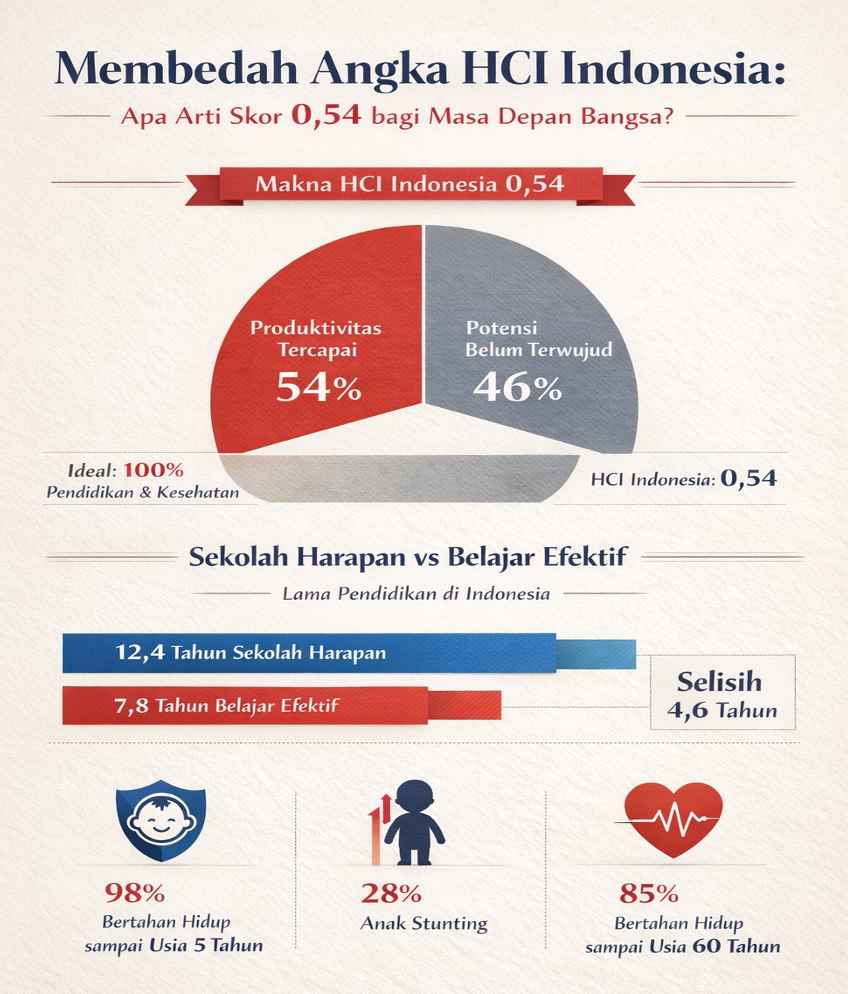
There is a number that may seem small, yet it raises a significant question about Indonesia’s future: 0.54. This is Indonesia’s Human Capital Index (HCI), according to the most recent profile available from the World Bank. This figure means that a child born in Indonesia today is expected, as an adult, to achieve only 54% of their potential productivity, compared to the ideal situation where they would receive full education and optimal health throughout their development.
At first glance, the number 0.54 may seem abstract. However, this is where its strength lies. HCI is not just an indicator of education or health. It is a concise measure of how effectively a country transforms childhood into productive human capital. The World Bank explains that HCI is built from several key components: the likelihood of a child surviving to age five, expected years of schooling, schooling years adjusted for learning quality, adult survival rates, and health indicators that affect long-term productivity.
In Indonesia’s profile, one of the most important findings is in the education component. Indonesian children are expected to attend about 12.4 years of school, but when adjusted for learning quality, the effective years drop to 7.8. This is called learning-adjusted years of schooling (LAYS). In other words, Indonesia’s problem is not just about access to school, but how much those years in school truly translate into meaningful learning.
The difference between 12.4 years of schooling and 7.8 years of effective learning is a powerful illustration of the challenges in Indonesia’s human development. It shows that simply attending class does not automatically equate to acquiring the expected knowledge and skills. The education system may successfully bring children to school for over a decade, but if the quality of learning is inadequate, the final outcomes will still be limited. This is where HCI serves as a clear tool: it separates how long children are in school from the actual capacity generated by the learning process.
This fact is important because future productivity does not emerge suddenly when someone enters the workforce. Productivity is shaped much earlier—during childhood—through a combination of nutrition, health, quality of care, school quality, and the ability of public systems to keep children healthy while they learn effectively. That is why HCI is often seen not just as a social indicator, but as a long-term economic one. When HCI is low, what is actually revealed is the growth potential that has yet to be fully developed.
For Indonesia, the 0.54 figure also needs to be understood in the context of development over time. The World Bank notes that Indonesia’s HCI value increased from 0.50 in 2010 to 0.54 in 2020. This indicates progress. However, that progress is not large enough to eliminate the fundamental reality that nearly half of the productivity potential of future generations remains unrealized. Therefore, the story of Indonesia’s HCI is not one of total stagnation, but one of real progress that is still not sufficient.
At this point, the most important question is not whether the 0.54 figure is “good” or “bad” morally. The question is: what does this number actually reveal about the quality of human development in Indonesia? The most direct answer is that Indonesia still faces a significant gap between access and quality. Children are relatively more likely to survive, more children are entering school, and they are staying in the education system for longer periods. But the accumulation of knowledge, skills, and health necessary to create a highly productive workforce is still suboptimal.
The concept of learning-adjusted years of schooling helps clarify this problem very clearly. According to the World Bank, LAYS is calculated by multiplying expected years of schooling by a learning quality measure derived from harmonized test scores. This means that LAYS is not simply about how long a child attends school, but how long that schooling is equivalent to high-quality learning. If a country has many years of schooling but poor learning quality, its LAYS value will decrease. In Indonesia’s case, the figure of 7.8 shows that learning quality remains a major challenge.
The implications of this are far-reaching. First, this figure shows that education reform cannot stop at expanding access. School infrastructure, participation, and the number of years spent in school remain important, but they are not enough. Policy focus needs to shift deeper into teacher quality, teaching quality in the classroom, assessments that truly measure student ability, and the system’s ability to address learning loss and fundamental educational gaps. Without this, simply increasing years of schooling will only lengthen the education journey without strengthening its outcomes.
Second, HCI emphasizes that education and health cannot be separated. A child who enters school with poor nutrition, fragile health, or grows up in an environment that does not support early development will find it harder to achieve optimal learning outcomes. Therefore, interpreting HCI 0.54 as merely an issue of schooling would be too narrow. It is also about maternal and child health, stunting, the quality of basic services, and ensuring healthy early development. The strength of HCI lies in its ability to show that human capacity is shaped by a complete life trajectory, not just one sector.
Third, this figure reminds us that a demographic dividend does not automatically translate into development dividends. Many countries hope that a large working-age population will boost the economy. However, without sufficient human quality, the demographic dividend can lose its leverage. A large youth population only becomes a force when a country ensures that their childhood is truly transformed into good health, quality education, and high productivity in adulthood. HCI is essentially a tool to measure how successful that process has been.
Of course, HCI is not a perfect measure. It does not capture the full range of human capabilities, nor does it fully account for creativity, character, regional inequalities, or institutional quality in detail. However, because it is concise, HCI is highly useful as a strong initial reading tool. It helps us see the big picture without getting lost in a pile of fragmented indicators. From this big picture, the message is clear: Indonesia has made progress, but its human capital foundation still needs to be seriously strengthened.
Therefore, reading Indonesia’s HCI of 0.54 should not stop at simply being concerned. This figure is more useful if it is understood as a call to refine human development priorities more sharply. It is not only about ensuring children attend school, but ensuring they learn well. It is not just about reducing mortality rates, but ensuring they develop healthily enough to support their learning and working capacity. It is not about increasing programs, but ensuring every intervention genuinely improves human quality.
In the end, the meaning of the 0.54 score for the nation’s future is both simple and weighty: Indonesia is still losing nearly half of the productivity potential of the generation born today. Meanwhile, the 7.8 years figure reminds us that the issue is not just whether children have been in school for a long time, but whether schools have provided them with enough quality learning to live and work productively. If these two numbers are read clearly, then HCI is no longer just an index. It becomes a mirror reflecting how far the nation has prepared for its future—and how much work is still left to be done.
Footnotes:
- World Bank, Human Capital Country Brief: Indonesia. This profile lists Indonesia’s HCI as 0.54, expected years of schooling at 12.4, and learning-adjusted years of schooling at 7.8.
- World Bank, The Human Capital Index 2020 Update: Human Capital in the Time of COVID-19. This methodological document explains that HCI measures the productivity of future generations relative to a benchmark of full education and full health.
- World Bank, Learning-Adjusted Years of School indicator page. This page explains the concept of LAYS as the number of years of schooling adjusted for learning quality.
- World Bank, Human Capital Project two-pager: Indonesia. This summary also includes Indonesia’s harmonized test score of approximately 395, which forms the basis for calculating LAYS.
- World Bank, Indonesia Human Capital Knowledge Series and World Bank reports on HCI in Indonesia highlight the increase in Indonesia’s HCI from 0.50 to 0.54 between 2010 and 2020.
Contributor:
Meiardhy Mujianto
“Dynamic Harmony between Human and Nature.”
-Relung Indonesia
Tags :
Knowledge Hub
Share This :
Category
- Ecosystem Restoration
- Biodiversity and Wildlife Conservation
- Community Ecological Education
- Digital Climate Action
- Climate Movement
- Knowledge Hub
- Sustainable Biodiversity-Based business
- Bioconversion and Bioprocessing-Based Business (4B)
- Sustainable Community-Based Tourism (SCBT)
- Integrated Agroforestry Initiatives
- Carbon Farming Initiative
- Basic service access and quality improvement for communities
- Livelihood Improvement Interventions
- Development of Social Networks and Cooperation
- Participatory Sustainable Livelihood Assesment
- Women's Empowerment Collective
Upcoming Events
Discussion: Disability and Social Inclusion
28
March
- Sleman, Yogyakarta
- 15.00 PM - 18.30 PM
Improving Facilitation Skills: Effective Techniques and Strategies
04
June
- Sleman, Yogyakarta
- 14.00 PM - 17.00 PM
Other Pages
Contact Info
- Omah Relung. Kalipentung RT03/RW17 Kalitirto Berbah Sleman Yogyakarta 55573.
- +62 851-7544-2708
- info@relung.or.id
Newsletter
Take care of the environment with Relung Indonesia Foundation! Get the latest information about forestry and the environment in Indonesia.
Relung Indonesia Foundation
Copyright © 2023. All rights reserved.