
Assessing the Resilience of Indonesia’s Smallholder Farmers Amid Geopolitical Crisis and Rising Input Costs
admin
April 1, 2026
Knowledge Hub
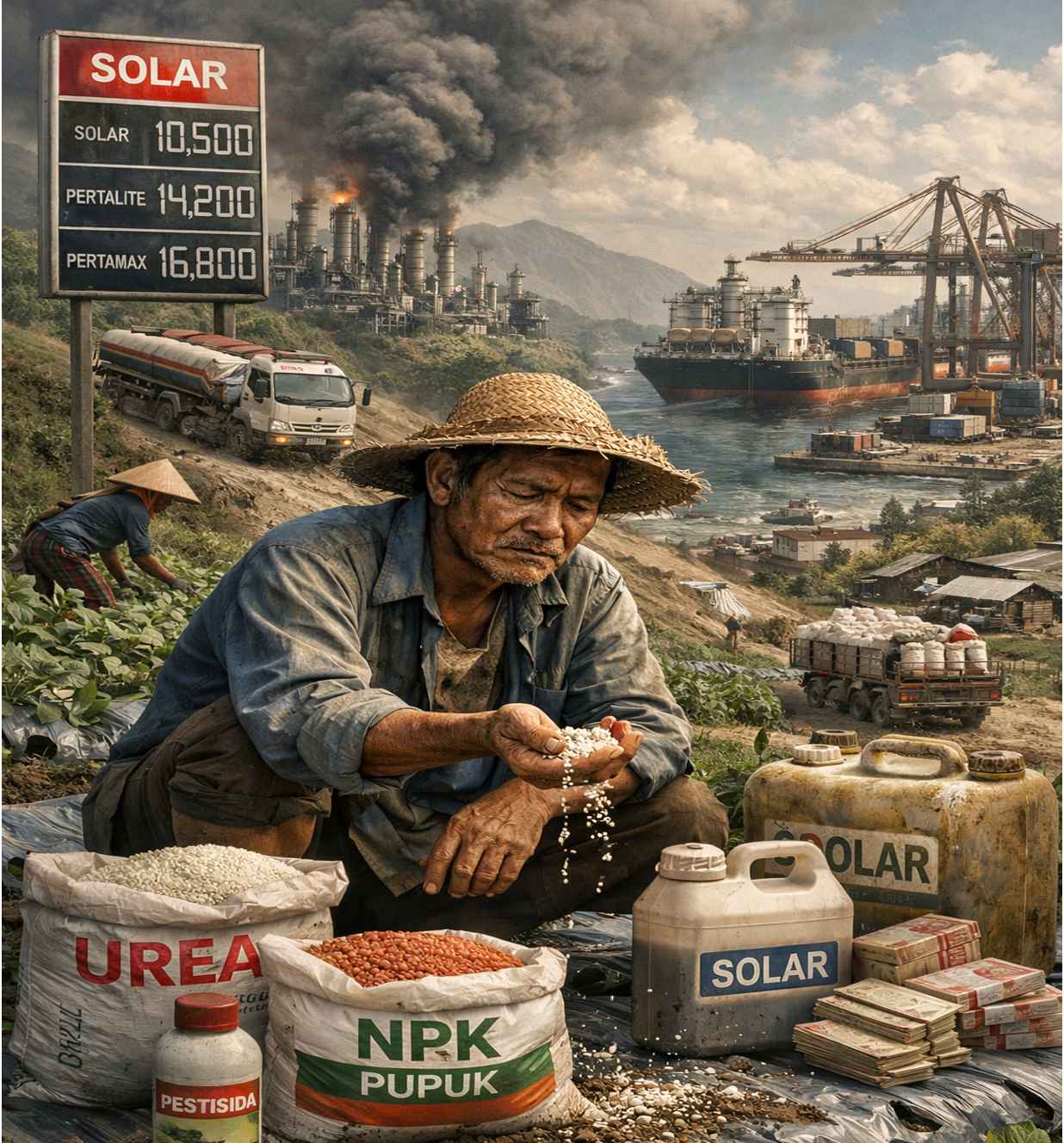
War in the Middle East may seem far removed from Indonesia’s rice fields and farmlands. In reality, it is not. When conflict involving Iran, the United States, and Israel disrupts global oil, fertilizer, and logistics systems, the impact falls hardest on those with the least economic buffer: smallholder farmers. The real question is no longer whether geopolitical crises affect Indonesian agriculture, but how long small farmers can endure rising production costs.
Indonesia is not facing war on its own soil. It is facing something equally disruptive: a surge in costs. Since tensions escalated, Brent crude has risen by nearly 60% throughout March 2026, while key energy and trade routes around the Strait of Hormuz remain under severe pressure. Reuters reports that refined product prices across Asia have climbed, alongside growing fears of prolonged supply disruptions. For Indonesia, the consequences extend far beyond fuel—they drive up transport costs, production expenses, and agricultural inputs.
This is where smallholder farmers come into focus. According to Statistics Indonesia (BPS), farmers cultivating less than 0.5 hectares number around 17.25 million out of 27.8 million agricultural land users nationwide. Most Indonesian farmers operate on narrow margins, with limited financial resilience. When fertilizer, diesel, plastic mulch, agrochemicals, and distribution costs rise at once, they are the first to absorb the shock.
The risks are already unfolding. Reuters reports that the Iran conflict is threatening fertilizer supplies across Asia ahead of the planting season, as disruptions around Hormuz constrain flows of fertilizer, raw materials, and fuel. Prices have surged, and analysts warn they could approach levels seen during the 2022 crisis if tensions persist. Bank Indonesia has likewise noted that the conflict is weakening global growth, disrupting trade, and intensifying inflationary pressures, including through rising commodity prices.
For small farmers, this is not abstract. It shapes daily decisions: whether to apply full fertilizer doses, cut pesticide use, delay mulch purchases, or absorb higher transport costs. In a system dependent on inputs sourced beyond the village, distant geopolitical shocks translate into immediate trade-offs on the farm. Smallholders have little room to maneuver. They lack capital reserves, independent supply buffers, and often the bargaining power to pass rising costs onto buyers.
The pressure is even more acute in mountainous regions and remote horticultural centers. In areas such as Petungkriyono, vegetable farmers face compounded risks—rising costs for plastic mulch, externally sourced poultry manure, chemical fertilizers, and crop protection inputs. At the same time, remoteness amplifies transport costs, making inputs even more expensive. Geopolitical shocks do not only move through global markets; they arrive through the cost of reaching the farm gate.
Logistics constraints make matters worse. Indonesia’s logistics costs remain high—around 14.29% of GDP in 2025—above many ASEAN peers. The Coordinating Ministry for Economic Affairs notes that these costs contribute to price disparities, inflation, and supply instability. In an archipelagic country, global energy shocks are magnified by an already inefficient distribution system. This is why remote agricultural regions feel the impact most intensely.
Resilience, therefore, cannot be reduced to the idea that farmers must simply “be strong.” It is not an individual trait—it is structural. It depends on cost systems, input access, market distance, soil capacity, and reliance on external supply chains. As long as agriculture depends heavily on fertilizers, chemicals, plastics, and fossil-fuel-based distribution, every geopolitical shock will continue to translate into higher costs for small farmers.
Yet this crisis also opens a critical question: will Indonesia continue to leave smallholders exposed within a fragile system, or begin shifting toward agriculture that relies less on external inputs and more on local resources? The urgency is clear. Reuters notes that disruptions in fertilizer and fuel supplies may reduce input use, alter cropping decisions, and place further pressure on food prices—particularly in developing economies.
For regions like Petungkriyono, the direction forward is evident. This is the moment to strengthen local organic fertilizer systems, improve village-level biomass cycles, and gradually reduce dependence on chemical inputs. The goal is not to eliminate modern inputs entirely, but to reduce reliance and increase local autonomy. The more soil fertility can be sustained locally, the less vulnerable farmers become to global price volatility and rising transport costs.
Smallholder resilience must therefore be redefined. It is not simply the ability to survive a crisis, but the capacity of a local agricultural system to remain stable when fertilizer supplies tighten, input prices rise, fuel becomes expensive, and distribution falters. By this measure, many small farmers in Indonesia are still operating within fragile systems. Without structural change, every geopolitical crisis will reappear as a cost crisis for those with the smallest landholdings and the narrowest margins.
This leads to a clear conclusion: today’s geopolitical crisis must serve as a turning point. Strengthening smallholder resilience requires more than short-term subsidies. It demands structural action—improving rural logistics, strengthening input distribution, supporting local organic fertilizers, reducing dependence on fossil-based materials, and promoting more input-efficient farming practices. Without this shift, smallholders will remain the first to bear global shocks—and the last to recover.
Assessing the resilience of Indonesia’s smallholder farmers ultimately means confronting a harder truth: the system itself must change. In an increasingly unstable world, that is no longer optional—it is necessary.
Contributor:
Meiardhy Mujianto
“Dynamic Harmony between Human and Nature.”
-Relung Indonesia
Tags :
Knowledge Hub
Share This :
Latest Blog
-
 A SCHOOL AT THE EDGE OF THE MOUNTAINS01 Sep 2026
 -
 THE REPUBLIC IN THE MOUNTAINS24 Aug 2026
 -
 When Living Spaces Shrink: Efforts to Maintain Harmony Between People and Elephants in South Sumatra20 Aug 2026
 -
 Relung Indonesia Entrusted to Support Five Provinces under the RBP REDD+ GCF Output 2 Financing Scheme13 Aug 2026
Category
- Ecosystem Restoration
- Biodiversity and Wildlife Conservation
- Community Ecological Education
- Digital Climate Action
- Climate Movement
- Knowledge Hub
- Sustainable Biodiversity-Based business
- Bioconversion and Bioprocessing-Based Business (4B)
- Sustainable Community-Based Tourism (SCBT)
- Integrated Agroforestry Initiatives
- Carbon Farming Initiative
- Basic service access and quality improvement for communities
- Livelihood Improvement Interventions
- Development of Social Networks and Cooperation
- Participatory Sustainable Livelihood Assesment
- Women's Empowerment Collective
Upcoming Events
Discussion: Disability and Social Inclusion
28
March
- Sleman, Yogyakarta
- 15.00 PM - 18.30 PM
Improving Facilitation Skills: Effective Techniques and Strategies
04
June
- Sleman, Yogyakarta
- 14.00 PM - 17.00 PM
Other Pages
Contact Info
- Omah Relung. Kalipentung RT03/RW17 Kalitirto Berbah Sleman Yogyakarta 55573.
- +62 851-7544-2708
- info@relung.or.id
Newsletter
Take care of the environment with Relung Indonesia Foundation! Get the latest information about forestry and the environment in Indonesia.
Relung Indonesia Foundation
Copyright © 2023. All rights reserved.