
The Story Behind a Cup of Kopi Luwung from the Petungkriyono Forest
admin
February 25, 2026
Knowledge Hub
The History of Coffee: From Africa to the Archipelago
Coffee has been enjoyed by people for centuries, originating in Africa during the 9th century. It then spread to the Middle East within the Islamic Empire and later to Europe and its colonies, eventually reaching every corner of the world, including Indonesia. Historically, coffee’s journey in Indonesia began in 1696 when the Dutch East India Company brought coffee seeds from Malabar, India. In 1707, Governor Van Hoorn distributed these seeds to Batavia, Cirebon, the Priangan region, and northern coastal areas of Java. After several attempts and adjustments, coffee cultivation successfully took root in Java between 1714 and 1715. Within just nine years, Java’s coffee production had flourished and surpassed Mocha (Yemen), dominating the European market.
Coffee cultivation grew rapidly under the Cultuurstelsel (Cultivation System) implemented in 1830. This system continued for coffee until 1915, while it ended for other crops by 1870, highlighting coffee’s critical role in the Dutch colonial economy.
The system spurred the expansion of plantations, particularly in the highlands, which led to widespread deforestation. Despite limited transportation and low buying prices, farmers were motivated to open new lands for coffee cultivation. The relatively low labor demands and distance from local authorities made coffee a preferred crop over indigo or sugar.
The importance of coffee for the colonial government’s finances is evident in the writings of Eduard Douës Dekker, using the pen name Multatuli. His 1859 work, Max Havelaar and the Coffee Auctions of the Dutch Trading Company, depicted the pressures faced by coffee farmers, which greatly influenced public opinion in the Netherlands and ultimately led to the demise of the Cultuurstelsel. Pramoedya Ananta Toer famously described Max Havelaar as “the writing that killed colonialism,” as it sparked new awareness and criticism of colonial land management practices.
Wong Petung and Kopi Luwung
Petungkriyono is a mountainous region with altitudes ranging from 600 to 2100 meters above sea level (masl), situated on the northern slopes of the Serayu Mountains. To the south lies the Dieng Plateau, with mountains such as Mount Rogojembangan, Mount Kendalisodo, Mount Sikeru, Mount Perbata, Mount Geni, and Mount Kukusan.
Located in the southern part of Pekalongan Regency, Petungkriyono borders Banjarnegara Regency to the south. The area spans 7,358.523 hectares, of which 5,189.507 hectares are state forests, and 119.652 hectares are residential areas (16%). Petungkriyono’s forest is among the last remaining tropical forests on Java, especially in Central Java, and supports endangered species such as the Javan eagle, leaf monkeys, panther cats, and the critically endangered Javan gibbon. The steep topography with limited flat land in river valleys likely contributed to the preservation of these forests and wildlife.
The population of Petungkriyono is around 13,000, spread across 9 villages. The majority of the residents identify as ‘Wong Petung,’ a term that reflects their distinct subculture. Evidence suggests settlements in Petungkriyono date back to the Mataram Hindu era, with archaeological remains and temples found in the area. The earliest recorded village, Telaga Pakis, was recognized by the colonial government in 1820.
The Cultivation of Kopi Luwung: Coffee from the Forest
Coffee cultivation began in the 1980s, initially hidden deep within the forest due to concerns over land status. Most coffee cultivated in these forests was of the robusta variety, with seedlings sourced from the Jolotigo Plantation, an old plantation that dates back to 1875. Arabica seedlings came from Tombo, Batang Regency, which also had a long-standing coffee-growing history.
Initially, coffee was cultivated for personal consumption. Seedlings, often wild-growing, were planted in gaps beneath the forest canopy. Robusta was the first variety to be planted, with Arabica introduced later. However, some areas still have remnants of the original Arabica Typica variety, the first coffee introduced to Java during colonial times. Later Arabica varieties, Red Caturra and Lini S, were sourced from Tombo.
After the 1998 reforms, coffee cultivation, especially robusta, expanded significantly. Farmers became more confident in accessing forest land, and with institutional support like LMDH (Forest Management Community Institution), coffee cultivation became legal. By this time, nearly every family in Petungkriyono had a coffee farm, typically ranging from 0.25 to 0.5 hectares. Arabica, though still grown in the forest, was mostly planted along the boundaries of vegetable fields or near settlements.
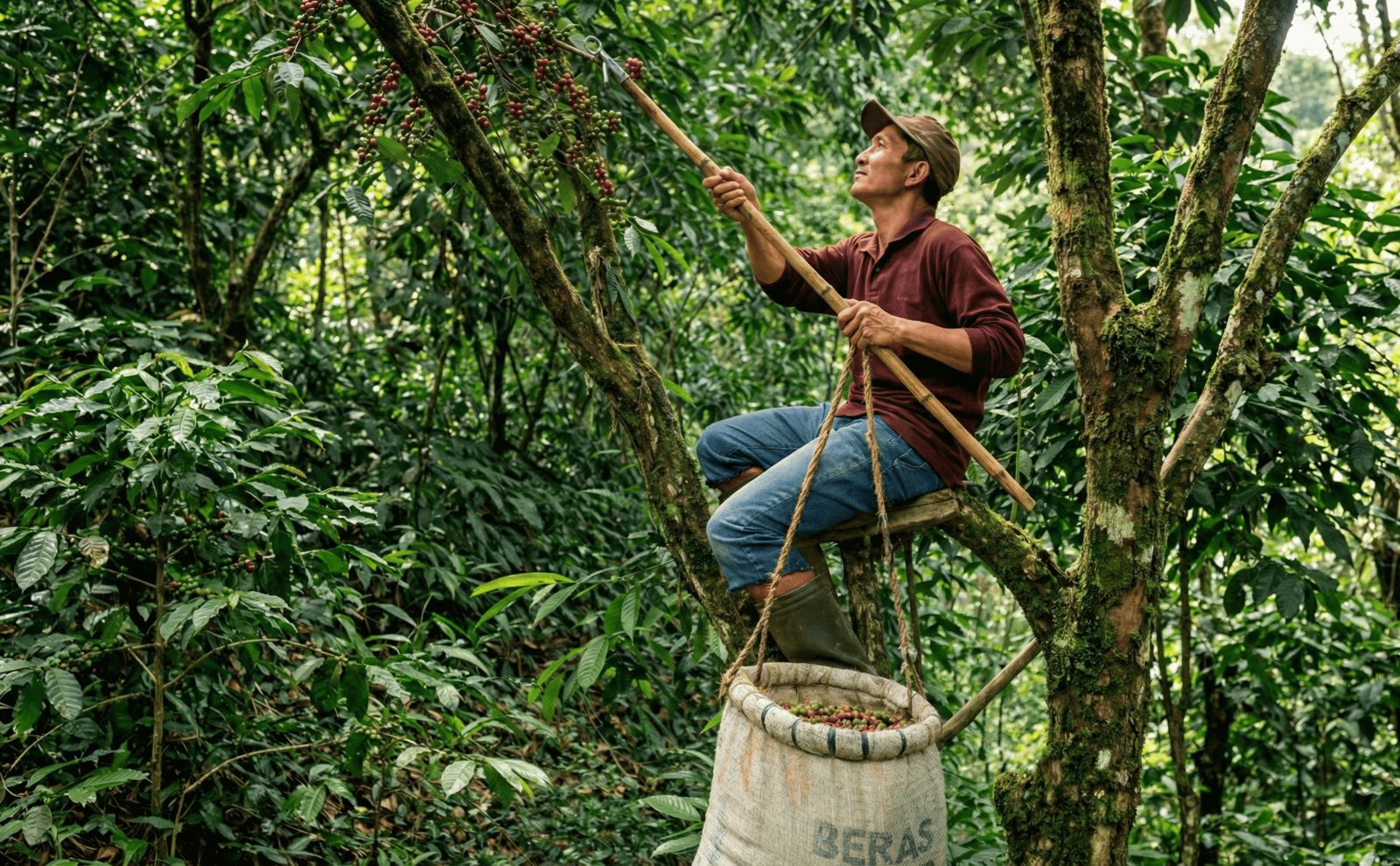
Petungkriyono’s farming methods are environmentally friendly, with minimal deforestation for coffee cultivation. Coffee is grown in gaps beneath the forest canopy, preserving the integrity of the forest. The land selected for cultivation is fertile, flat, and relatively close to settlements, making harvesting easier.
Locally, this cultivation method is known as Kopi Luwung, with luwng meaning forest in ancient Javanese. Internationally, it is referred to as shade-grown coffee, a sustainable model of cultivation.
Sustainable Coffee Cultivation: A Unique Tradition
Shade-grown coffee is categorized into rustic, traditional polyculture, commercial polyculture, and shade monoculture. The majority of Petungkriyono’s coffee farms fall under the rustic category, where coffee plants coexist with various forest species, creating a multi-strata system and serving as a habitat for wildlife.
Seedlings used are typically collected from existing coffee plants. The land is cleared of underbrush, and planting holes are dug. The seedlings are planted without any fertilizers. Once planted, no further treatment is done except for weed control around the roots. The plants grow freely, reaching heights of 3 to 7 meters. After about 10 years, if productivity declines, plants are cut back to a 30-50 cm stump to encourage new shoots that will be ready for harvest in 2-3 years. This practice is called trubusan, where part of the plants are cut while others remain for a continuous harvest.
Before harvesting, farmers check their coffee farms in early dry season (March-April) to assess whether the coffee trees have borne fruit. Harvesting is done manually, with fruit picked from trees using a bamboo pole. The fruit is harvested all at once, regardless of ripeness, for labor efficiency. The harvested fruit is then carried back to the farmhouses, often on their backs through slippery, steep forest paths. On average, a farmer can harvest about 100 kg of coffee per day.
After harvesting, the fruit is either dried naturally (natural process) or peeled using a traditional pulper, giser. Once dried, the green coffee beans are hulled at local depots. If farmers don’t intend to sell immediately, they store the beans in dry form to preserve them.
Once processed into green coffee beans, farmers typically sell them to local collectors or traders. Most farmers sell their harvest to meet immediate expenses, though some may store it for future use.
For personal consumption, farmers set aside some of their harvest, especially from ripe red fruits, to roast manually. There is also a tradition of gorek, where women search the forest floor for fallen coffee cherries after the harvest season. Occasionally, they find kopi luwak, coffee that has passed through the digestive tract of civet cats.
The Value of Kopi Luwung
While the coffee yield is lower than that of intensive farming methods, the unique flavor profile is prized. The forest soil’s complex nutrient demands and slower sugar maturation process contribute to the coffee’s exceptional taste. Robusta coffee from Petungkriyono consistently scores above 80 in quality assessments, placing it in the fine robusta category.
Despite the lower productivity, the high quality of the coffee justifies higher market prices. Kopi Luwung from Petungkriyono is not merely a beverage; it is a reflection of local wisdom, sustainability, and exceptional flavor that offers a distinctive coffee experience.
This story of Petungkriyono’s Kopi Luwung reminds us of the long journey coffee has taken, from colonial history to modern, environmentally conscious cultivation practices.
Contributor:
Meiardhy Mujianto
“Dynamic Harmony between Human and Nature.”
-Relung Indonesia
Tags :
Knowledge Hub
Share This :
Category
- Ecosystem Restoration
- Biodiversity and Wildlife Conservation
- Community Ecological Education
- Digital Climate Action
- Climate Movement
- Knowledge Hub
- Sustainable Biodiversity-Based business
- Bioconversion and Bioprocessing-Based Business (4B)
- Sustainable Community-Based Tourism (SCBT)
- Integrated Agroforestry Initiatives
- Carbon Farming Initiative
- Basic service access and quality improvement for communities
- Livelihood Improvement Interventions
- Development of Social Networks and Cooperation
- Participatory Sustainable Livelihood Assesment
- Women's Empowerment Collective
Upcoming Events
Discussion: Disability and Social Inclusion
28
March
- Sleman, Yogyakarta
- 15.00 PM - 18.30 PM
Improving Facilitation Skills: Effective Techniques and Strategies
04
June
- Sleman, Yogyakarta
- 14.00 PM - 17.00 PM
Other Pages
Contact Info
- Omah Relung. Kalipentung RT03/RW17 Kalitirto Berbah Sleman Yogyakarta 55573.
- +62 851-7544-2708
- info@relung.or.id
Newsletter
Take care of the environment with Relung Indonesia Foundation! Get the latest information about forestry and the environment in Indonesia.
Relung Indonesia Foundation
Copyright © 2023. All rights reserved.