
When El Niño Meets War: Testing the Resilience of Indonesia’s Smallholder Farmers
admin
April 6, 2026
Knowledge Hub
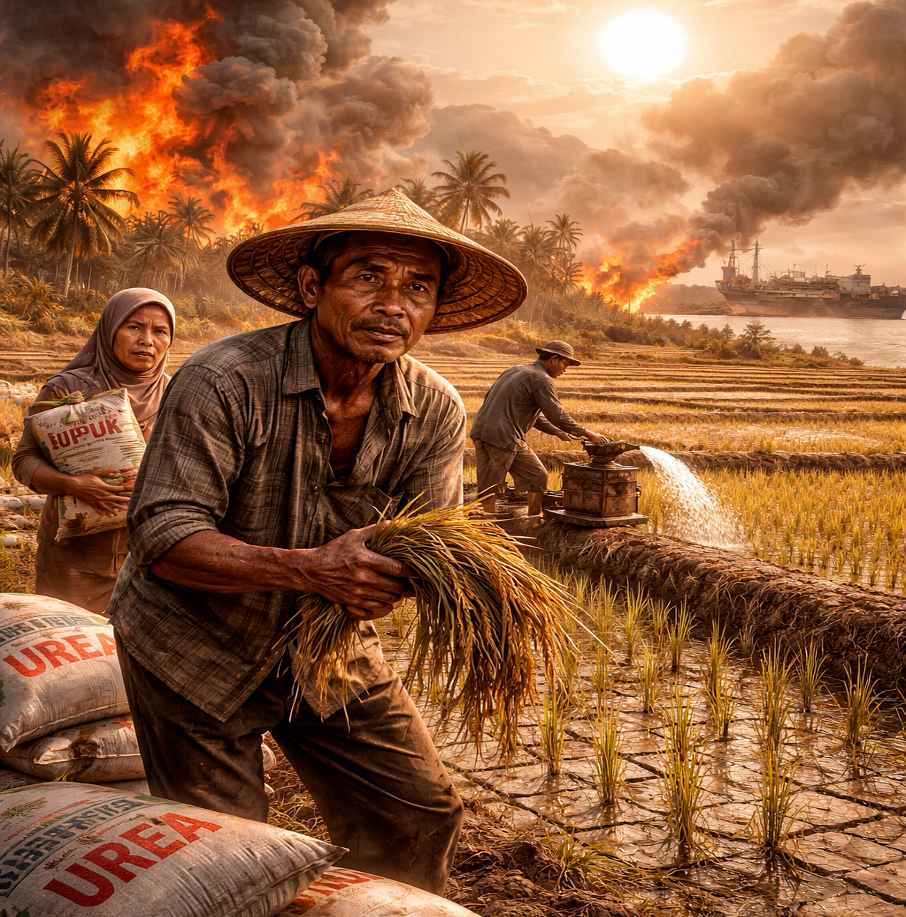
An early dry season rarely comes alone. It brings cracked fields, shrinking wells, rising planting costs, and a creeping strain on farming households. In 2026, that pressure is intensifying. Indonesia is bracing for a dry season that may arrive earlier, last longer, and hit harder across many regions. At the same time, prolonged conflict in the Middle East is disrupting global energy and fertilizer systems, pushing agricultural costs upward far beyond the war zone. What is at stake is not just crop yields, but the resilience of millions of smallholder farmers.
Public discourse has framed this risk as “El Niño 2026.” Yet even without an official extreme classification, the warning signs are already clear. Indonesia’s Meteorology, Climatology, and Geophysics Agency (BMKG) projects that 64.5% of seasonal zones will face below-normal rainfall, with most regions reaching peak dryness in August and over half experiencing longer-than-usual dry seasons. Many agricultural areas will enter high-risk conditions precisely when water availability, planting schedules, and crop resilience are under pressure.
For Indonesia, this goes beyond weather. Agriculture remains central to livelihoods, employing 28.2% of the workforce and contributing an average of 13.1% to GDP over the past decade. Yet the system rests on a fragile base. The World Bank estimates that 93% of agricultural producers are small family operations, with most farming on less than one hectare. National data further shows that a large share cultivates less than 0.5 hectares—leaving little margin to absorb shocks.
This is where climate stress intersects with geopolitical disruption. Conflict in the Middle East is not only driving oil volatility; it is also constraining global fertilizer supply chains. UNCTAD reports that traffic through the Strait of Hormuz has dropped sharply, despite its critical role in energy and fertilizer trade. The result is a simultaneous increase in energy, fertilizer, and transport costs. For farmers, this translates directly into higher input prices and tougher decisions about whether planting remains viable.
The danger lies in this dual pressure. As rainfall declines, farmers must spend more to sustain production—on irrigation, pumps, labor, and crop protection. At the same time, input prices are rising. Smallholder incomes, already limited and diversified, leave little buffer. When drought and cost shocks occur together, their room to maneuver shrinks rapidly.
On the ground, responses are often immediate but costly in the long run. Farmers reduce fertilizer use, delay planting, switch to less profitable crops, or take on short-term debt. While rational in the moment, these decisions can trigger a downward cycle: lower yields, weaker income, reduced capacity to invest, and greater risk in the next season. This layered crisis is rarely visible in national statistics, which tend to focus on aggregate supply. At the household level, the question is far more immediate: can the season be sustained without selling assets or compromising basic needs?
The risks deepen as dry landscapes become more fire-prone. Prolonged drought does not only threaten crops—it increases the likelihood of widespread fires. In Indonesia, this risk is well established. As vegetation and soils lose moisture, fire becomes systemic rather than incidental, threatening farms, water systems, public health, and rural economies simultaneously.
This makes smallholder resilience a central issue. Resilience does not mean enduring shocks alone; it means the capacity to absorb, adapt, and recover without collapse. In practice, this requires recognizing that climate stress, rising input costs, logistical disruption, and fire risk are interconnected. Misaligned planting calendars increase vulnerability. Heavy reliance on external inputs amplifies exposure to global shocks. Weak farmer institutions limit bargaining power in times of scarcity.
The future of Indonesian agriculture therefore depends not only on national food reserves, but on the strength of farming households themselves. Climate information must be accessible and actionable at the village level. Farming systems must reduce dependence on volatile external inputs. Soil health, water conservation, crop diversification, cooperative strengthening, and input-efficient practices are no longer optional—they are essential.
Ultimately, the test in 2026 is not just about weather patterns or fertilizer prices. It is about whether Indonesia can respond to overlapping crises with structural resilience. National supply may hold. But real food security is built on small farms that remain cultivated, water sources that endure, and farming families that can continue. In an increasingly uncertain world, smallholder farmers are not simply vulnerable—they are decisive.
Contributors:
Meiardhy Mujianto
“Dynamic Harmony between Human and Nature.”
-Relung Indonesia
Tags :
Knowledge Hub
Share This :
Category
- Ecosystem Restoration
- Biodiversity and Wildlife Conservation
- Community Ecological Education
- Digital Climate Action
- Climate Movement
- Knowledge Hub
- Sustainable Biodiversity-Based business
- Bioconversion and Bioprocessing-Based Business (4B)
- Sustainable Community-Based Tourism (SCBT)
- Integrated Agroforestry Initiatives
- Carbon Farming Initiative
- Basic service access and quality improvement for communities
- Livelihood Improvement Interventions
- Development of Social Networks and Cooperation
- Participatory Sustainable Livelihood Assesment
- Women's Empowerment Collective
Upcoming Events
Discussion: Disability and Social Inclusion
28
March
- Sleman, Yogyakarta
- 15.00 PM - 18.30 PM
Improving Facilitation Skills: Effective Techniques and Strategies
04
June
- Sleman, Yogyakarta
- 14.00 PM - 17.00 PM
Other Pages
Contact Info
- Omah Relung. Kalipentung RT03/RW17 Kalitirto Berbah Sleman Yogyakarta 55573.
- +62 851-7544-2708
- info@relung.or.id
Newsletter
Take care of the environment with Relung Indonesia Foundation! Get the latest information about forestry and the environment in Indonesia.
Relung Indonesia Foundation
Copyright © 2023. All rights reserved.