
BUMDes at a Crossroads
admin
June 17, 2026
Opinion
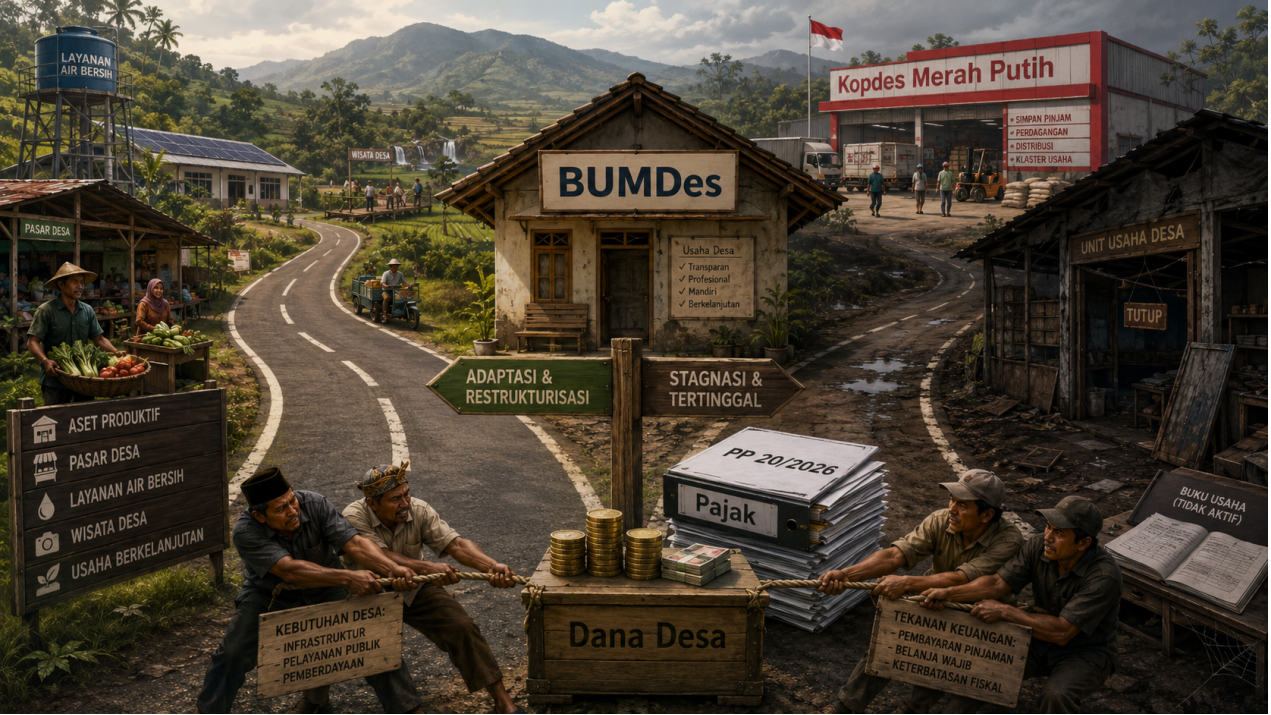
Village-Owned Enterprises (Badan Usaha Milik Desa or BUMDes) were once positioned as one of the primary instruments for driving rural economic development. On paper, their role is strategic: they are owned by the village, established through village deliberations, and designed to manage local economic potential so that the benefits flow back to the community. However, in recent years, BUMDes have entered a more challenging phase. It is no longer a phase of establishment, but a phase of proving their relevance and effectiveness.
Today, BUMDes stand at a crossroads. On one hand, the number of BUMDes and BUMDes Bersama (Joint Village-Owned Enterprises) nationwide has grown substantially. As of June 2, 2026, Indonesia had 73,602 BUMDes and BUMDes Bersama, consisting of 67,102 BUMDes and 6,500 BUMDes Bersama. Of these, 45,916 BUMDes and 1,965 BUMDes Bersama had obtained legal entity status.[1] These figures indicate that institutionally, BUMDes are no longer a small-scale phenomenon.
However, large numbers do not necessarily translate into strong capacity. Operationally, many BUMDes continue to face fundamental challenges: inactive business units, weak financial reporting, inadequate business planning, and unprofessional governance. The Financial and Development Supervisory Agency (BPKP) reported that approximately 75.8% of BUMDes were active, while 24.2% were inactive.[2] In another assessment, BPKP found that 88% of sampled BUMDes in 2024 had not prepared adequate business plans.[3]
These findings are significant because they reveal that the primary challenge facing BUMDes is no longer legal status. The more fundamental issue is business quality. Many BUMDes were established as a response to policy mandates rather than as enterprises driven by clearly identified market needs. Many also received village capital injections without conducting feasibility studies, developing marketing strategies, implementing accounting systems, or establishing robust oversight mechanisms.
In this context, changes in tax policy through Government Regulation (PP) No. 20 of 2026 represent an important signal. This regulation revises the provisions governing the final income tax regime for Micro, Small, and Medium Enterprises (MSMEs), previously regulated under PP No. 55 of 2022. The 0.5% final income tax scheme for taxpayers with certain gross revenues is now directed specifically toward individual taxpayers, sole-shareholder corporations established by a single person, and cooperatives.[5] Consequently, BUMDes are no longer among the primary beneficiaries of this facility, except under transitional provisions where their previous utilization period has not yet expired.
Technically, this tax reform may appear to be an administrative issue. Economically and politically, however, its implications are much broader. BUMDes lose one of the fiscal conveniences that previously simplified their tax administration. For BUMDes with orderly bookkeeping systems, the impact may be manageable. However, for those with weak financial records, this change creates significant pressure. They must adopt more rigorous accounting practices, calculate profits more accurately, and fulfill tax obligations through stronger governance systems.
At the same time, the government is actively promoting the establishment of the Red-and-White Village/Subdistrict Cooperatives (Koperasi Desa/Kelurahan Merah Putih or Kopdes Merah Putih). Through Presidential Instruction (Inpres) No. 9 of 2025, the government set a target of establishing 80,000 Kopdes Merah Putih, with activities ranging from retail stores and savings-and-loan services to clinics, pharmacies, cold storage facilities, warehousing, and logistics services.[6] On July 21, 2025, the government officially launched 80,081 Red-and-White Village/Subdistrict Cooperatives.[7]
At this point, the situation facing BUMDes becomes more complex. Kopdes Merah Putih are not merely additional institutions; they have the potential to become new centers of gravity within the rural economy. The sectors promoted for Kopdes—retail trade, savings and loans, logistics, warehousing, agricultural distribution, and essential services—are the very sectors that many BUMDes have also sought to develop.
Without a clear division of roles, BUMDes and Kopdes may end up operating within the same economic space. They could compete for members, social capital, village government support, local markets, and even financing opportunities. In such circumstances, villages risk having too many economic institutions but too few genuinely healthy business entities.
Another issue concerns village fiscal capacity. Ministry of Finance Regulation (PMK) No. 15 of 2026 regulates the disbursement of General Allocation Funds (DAU), Revenue Sharing Funds (DBH), and Village Funds to accelerate the development of physical infrastructure for Kopdes Merah Putih, including retail outlets, warehouses, and supporting facilities. Under this regulation, financing for a Kopdes retail facility may reach up to IDR 3 billion per unit, with a 6% annual interest, margin, or profit-sharing rate, a 72-month tenor, and repayment mechanisms that may utilize DAU, DBH, or Village Funds.[8]
This provision requires careful consideration. On one hand, investments in retail and warehousing infrastructure can strengthen the rural economy. On the other hand, they also create fiscal consequences. Village Funds are not unlimited. For Fiscal Year 2026, the Village Fund allocation was set at IDR 60.57 trillion.[9] When part of this fiscal space is directed toward supporting Kopdes infrastructure, the capacity of villages to provide additional capital injections to BUMDes may diminish.
In other words, BUMDes face a triple challenge. From a taxation perspective, they lose a fiscal advantage that previously provided breathing room for small enterprises. From a village finance perspective, they must compete with new policy priorities. From an institutional perspective, they face the emergence of Kopdes Merah Putih, which enjoy strong political and policy support.
Yet the logical conclusion is not that BUMDes will disappear. A more accurate conclusion is that BUMDes will undergo a process of selection. BUMDes that survive solely through village capital injections without a clear business model are likely to stagnate or become merely administrative entities. Those whose business activities overlap with Kopdes without offering any competitive advantage will also come under pressure. Conversely, BUMDes capable of redefining their role still have room for a viable future.
The future of BUMDes lies in specialization. BUMDes do not need to be everything for everyone. They do not necessarily need to operate retail stores if Kopdes are better positioned to manage basic commodity distribution. Nor do they need to run savings-and-loan services if cooperatives are institutionally better suited for that role. Instead, BUMDes may be more effective when focused on managing village assets, delivering economic public services, undertaking productive investments, developing businesses based on local potential, and facilitating commercial partnerships that require a formal village mandate.
Within this framework, BUMDes can serve as managers of village markets, clean water systems, tourism destinations, production facilities, kiosks and other village assets, local service providers, or holders of village investments in partnership schemes. Meanwhile, Kopdes Merah Putih can focus on member-based cooperative functions such as goods distribution, productive financing, procurement of agricultural inputs, collection of agricultural and livestock products, and the provision of daily economic services to residents.
This division of roles is important because legally, BUMDes were specifically designed as village-owned legal entities responsible for village business activities. Government Regulation No. 11 of 2021 governs all aspects of BUMDes, including establishment, bylaws, organizational structures, work plans, capital, assets, loans, business units, procurement, partnerships, accountability mechanisms, profit-sharing arrangements, losses, and business termination.[4] In other words, BUMDes continue to have a legitimate place within Indonesia’s regulatory framework. What has changed is the strategic environment in which they operate.
Therefore, the future of BUMDes will depend heavily on the ability of villages and BUMDes managers to accomplish three things. First, they must conduct honest business audits. Unprofitable business units should be evaluated rather than continually funded in the name of empowerment. Second, they must improve bookkeeping and governance systems. Tax reforms require BUMDes to move beyond informal management practices. Third, they must develop a clear role-sharing framework with Kopdes Merah Putih to ensure that both institutions complement rather than undermine one another.
BUMDes ranking systems should also be viewed as more than administrative formalities. The national BUMDes and BUMDes Bersama ranking framework evaluates institutional strength, management quality, business performance, partnerships, assets and capital, reporting and accountability systems, as well as benefits generated for villages and communities.[10] These seven dimensions can serve as valuable diagnostic tools: is a BUMDes truly functioning as a business entity, or is it merely an institution that exists on paper?
Viewed objectively, these developments suggest that BUMDes are transitioning from an era of protection to an era of discipline. During the protection era, many BUMDes could be established through policy incentives and capital injections. In the discipline era, BUMDes must demonstrate that they have viable businesses, sound bookkeeping systems, tangible benefits, and clearly defined positions within the rural economic ecosystem.
For some BUMDes, this transition will be difficult. Yet from a public policy perspective, such a selection process is not necessarily negative. Villages do not need numerous economic institutions that exist only on paper. They need a smaller number of institutions that are genuinely healthy, accountable, beneficial, and fiscally sustainable.
Therefore, the key question for the future is no longer, “Are BUMDes still necessary?” A more relevant question is, “What kind of BUMDes deserve to be sustained?”
The answer is straightforward, though demanding: BUMDes worth sustaining are those that can evolve from recipients of capital into rational business entities. They are BUMDes that exist not merely because regulations require them, but because they fulfill a clear economic function. They are BUMDes that do not compete blindly with Kopdes, but instead identify and occupy their own areas of specialization. They are BUMDes that do not become burdens on villages, but rather serve as instruments for managing assets, investments, and long-term economic benefits.
At this crossroads, BUMDes are not facing an ending. They are facing a test of maturity. Those unprepared for change will remain as administrative structures. Those capable of adaptation will endure as leaner, more focused, and more accountable village economic institutions.
References and Data Sources
- National BUMDes and BUMDes Bersama data as of June 2, 2026: 73,602 entities in total, comprising 67,102 BUMDes and 6,500 BUMDes Bersama; 45,916 BUMDes and 1,965 BUMDes Bersama had obtained legal entity status.
https://sid.kemendesa.go.id/bumdes - BPKP statement indicating that approximately 75.8% of BUMDes are active and 24.2% inactive, alongside factors contributing to their slow development, including limited capital, productivity, market access, information, and technology.
https://www.antaranews.com/berita/4392098/bpkp-sebut-baru-758-persen-bumdes-di-indonesia-yang-aktif - BPKP finding that 88% of sampled BUMDes in 2024 had not prepared adequate business plans.
https://www.bpkp.go.id/id/berita/mDmV/transformasi-ekonomi-desa-penguatan-bumdes-sebagai-penggerak-ekonomi-desa - Government Regulation No. 11 of 2021 concerning Village-Owned Enterprises (BUMDes), governing establishment, bylaws, organization, work plans, capital, assets, loans, business units, partnerships, accountability, profit-sharing, losses, and business termination.
https://peraturan.bpk.go.id/Details/161841/pp-no-11-tahun-2021 - Government Regulation No. 20 of 2026 revising the MSME final income tax scheme, which is now directed toward individual taxpayers, sole-shareholder corporations, and cooperatives, with transitional provisions for CVs, partnerships, limited liability companies, and BUMDes whose utilization periods have not yet expired.
https://news.ddtc.co.id/berita/nasional/1819737/pp-direvisi-pph-final-umkm-cuma-untuk-op-pt-perorangan-dan-koperasi - Presidential Instruction No. 9 of 2025 on accelerating the establishment of Red-and-White Village/Subdistrict Cooperatives, including the target of 80,000 cooperatives and activities such as retail stores, savings and loans, clinics, pharmacies, cold storage facilities, warehousing, and logistics services.
https://setneg.go.id/baca/index/inilah_inpres_9_2025_tentang_percepatan_pembentukan_koperasi_desa_kelurahan_merah_putih - Official launch of 80,081 Red-and-White Village/Subdistrict Cooperatives on July 21, 2025.
https://setkab.go.id/presiden-prabowo-resmikan-kelembagaan-80-081-koperasi-desa-kelurahan-merah-putih/ - Ministry of Finance Regulation No. 15 of 2026 concerning the disbursement of DAU, DBH, and Village Funds to accelerate the development of physical facilities for Red-and-White Village/Subdistrict Cooperatives, including financing limits of up to IDR 3 billion per unit, a 6% annual interest/profit-sharing rate, a 72-month tenor, and repayment mechanisms through DAU, DBH, or Village Funds.
https://perpajakan.ddtc.co.id/id/sumber-hukum/peraturan-pusat/peraturan-menteri-keuangan-15-tahun-2026 - Ministry of Finance Regulation No. 7 of 2026 establishing the Fiscal Year 2026 Village Fund allocation at IDR 60.57 trillion.
https://perpajakan.ddtc.co.id/id/sumber-hukum/peraturan-pusat/peraturan-menteri-keuangan-7-tahun-2026 - Minister of Villages, Development of Disadvantaged Regions, and Transmigration Decree No. 145 of 2022 on the BUMDes/BUMDes Bersama Ranking Formula, which evaluates institutional performance, management, business operations, partnerships, assets and capital, reporting and accountability systems, and benefits generated for villages and communities.
https://assets.kanaldesa.com/2023-03/Kepmendesa-145-2022-Formula%20Pemeringkatan%20BUM%20Desa%20BUM%20Desa%20Bersama.pdf
Contributor:
Meiardhy Mujianto
“Dynamic Harmony between Human and Nature.”
-Relung Indonesia
Tags :
Opinion
Share This :
Latest Blog
-
 Kemongkong: Preserving the Boundary Between Farmland, Forest, and Wild Boars in Petungkriyono08 Jul 2026
 -
 Agroforestry and Karst Carbon: The Hidden Climate Potential Beneath Limestone Mountains26 Jun 2026
 -
 Lessons from EWCF: Agroforestry and the Foundations of an Inclusive Rural Economy24 Jun 2026
 -
BUMDes at a Crossroads17 Jun 2026
Category
- Ecosystem Restoration
- Biodiversity and Wildlife Conservation
- Community Ecological Education
- Digital Climate Action
- Climate Movement
- Knowledge Hub
- Sustainable Biodiversity-Based business
- Bioconversion and Bioprocessing-Based Business (4B)
- Sustainable Community-Based Tourism (SCBT)
- Integrated Agroforestry Initiatives
- Carbon Farming Initiative
- Basic service access and quality improvement for communities
- Livelihood Improvement Interventions
- Development of Social Networks and Cooperation
- Participatory Sustainable Livelihood Assesment
- Women's Empowerment Collective
- News
Upcoming Events
Discussion: Disability and Social Inclusion
28
March
- Sleman, Yogyakarta
- 15.00 PM - 18.30 PM
Improving Facilitation Skills: Effective Techniques and Strategies
04
June
- Sleman, Yogyakarta
- 14.00 PM - 17.00 PM
Other Pages
Contact Info
- Omah Relung. Kalipentung RT03/RW17 Kalitirto Berbah Sleman Yogyakarta 55573.
- +62 851-7544-2708
- info@relung.or.id
Newsletter
Take care of the environment with Relung Indonesia Foundation! Get the latest information about forestry and the environment in Indonesia.
Relung Indonesia Foundation
Copyright © 2023. All rights reserved.