
Agroforestry and Karst Carbon: The Hidden Climate Potential Beneath Limestone Mountains
admin
June 26, 2026
Knowledge Hub
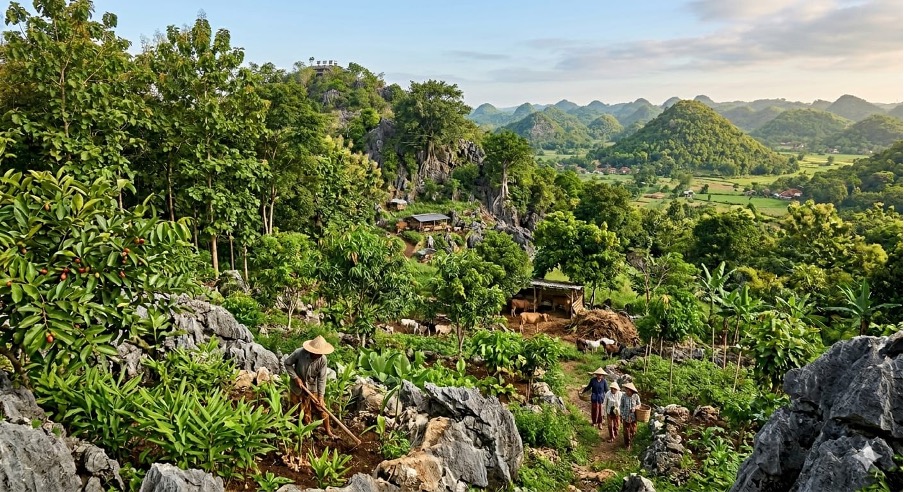
For many people, karst landscapes are often perceived as dry, barren, and marginal environments. Yet beneath their seemingly harsh appearance lies one of Earth’s most remarkable geochemical secrets: karst ecosystems are among the planet’s most effective natural systems for absorbing and storing atmospheric carbon. The primary challenge is finding land-use approaches that balance local livelihoods with the conservation of these unique landscapes. One promising answer is agroforestry.
Karst: Earth’s Underground Carbon Vault
How can limestone capture carbon?
The answer lies in the remarkable geochemical processes that occur within karst ecosystems. Karst is far more than inert rock; it is a dynamic landscape that continuously interacts with the atmosphere through vegetation, soil, and water.
As trees grow on karst terrain, their roots release carbon dioxide (CO₂) into the soil through root respiration. When rainfall infiltrates the ground, it combines with this CO₂ to form weak carbonic acid. This naturally acidic water gradually dissolves limestone (CaCO₃), initiating one of nature’s most important carbon sequestration mechanisms.
Natural Karst Chemical Reaction |
Through this natural process, atmospheric carbon dioxide is converted into dissolved bicarbonate, which travels through underground water systems before eventually precipitating as stalactites and stalagmites within caves. In this form, carbon becomes locked within geological formations for extremely long periods, effectively removing it from the atmosphere.
Maximizing Karst Potential Through Organic Land Management
Karst landscapes are characterized by shallow soils that are highly sensitive to ecological disturbance. Consequently, maintaining permanent vegetation cover is essential for sustaining this natural carbon sequestration cycle.
In dryland karst farming systems, intensive soil disturbance and excessive application of nitrogen-based chemical fertilizers may disrupt the area’s delicate geochemical balance. Nitrogen-driven nitrification can unnaturally increase soil acidity, potentially accelerating the release of CO₂ from limestone back into the atmosphere over time.
To preserve karst ecosystems as effective natural carbon sinks, land management practices should protect soil structure while maintaining soil fertility through sustainable nutrient cycling.
Agroforestry: A Win–Win Solution for Rural Livelihoods and Karst Conservation
Agroforestry provides an ideal balance between environmental conservation and economic productivity, particularly in regions such as Gunungkidul. Building upon the traditional tegalan farming system, agroforestry organizes vegetation into three complementary vertical layers.
| Vegetation Layer | Representative Species | Ecological and Economic Functions |
|---|---|---|
| Upper Canopy (Overstory) | Teak, Mahogany, Ficus (Banyan/Preh), Kepuh | Deep-rooted trees such as Ficus and Kepuh penetrate limestone fractures, transporting carbon deeper into the rock through root respiration while providing long-term timber investments. |
| Middle Layer (Midstory) | Melinjo, Mango, Jackfruit, Sugar Apple, Soursop, Guava, Sapodilla, Tamarind, Dryland Avocado | Generates seasonal income through fruits and melinjo seeds, diversifies household nutrition, and reduces dependence on a single commodity. |
| Lower Layer (Understory) | Ginger, Turmeric, Java Turmeric, Aromatic Ginger, Arrowroot, Canna, Galangal | Thrives in naturally fertile depressions between limestone outcrops, requires minimal soil disturbance, minimizes erosion risk, and offers strong market value for rhizomes and starch crops. |
Integrating Livestock for a Circular Nutrient System
Agroforestry becomes even more resilient when integrated with cattle or goats. Forage grasses and leguminous species such as gliricidia and calliandra are cultivated among limestone outcrops to provide high-quality livestock feed.
Animal manure is subsequently composted and returned to the land as organic fertilizer, creating a closed-loop, zero-waste nutrient cycle. This system maintains natural soil chemistry, enhances soil fertility, and supports optimal geochemical carbon sequestration within karst formations.
Looking Ahead: Karst Landscapes as Climate Assets
Protecting karst ecosystems does not require sacrificing rural economic development. Agroforestry demonstrates that community prosperity and ecological conservation can reinforce one another.
Local communities can harvest spices throughout the year, sell seasonal fruits, raise livestock for long-term income, and invest in timber production. Simultaneously, permanent vegetation cover sustains the underground geochemical processes that lock atmospheric carbon into karst formations, transforming limestone landscapes into valuable natural allies in climate change mitigation.
Rather than being viewed as barren wastelands, karst regions should be recognized as productive landscapes with immense ecological value. Through well-designed agroforestry systems, these unique environments can simultaneously strengthen rural livelihoods, conserve biodiversity, and contribute significantly to long-term carbon sequestration.
References
- Haryono, E., & Day, M. (2004). Landform Differentiation within the Gunung Sewu Kegelkarst, Java, Indonesia. Journal of Cave and Karst Studies, 66(2), 62–69.
- Purwanto, R. H., et al. (2022). Analysis of Intensified Agrosilvopastoral Farming in Wiladeg Village, Karangmojo Sub-district, Gunungkidul Regency, Special Region of Yogyakarta, Indonesia. Jurnal Ilmu Kehutanan, 16(2), 184–197.
- Sulistiyowati, E., Setiadi, S., & Haryono, E. (2023). The Dynamics of Sustainable Livelihoods and Agroforestry in the Gunungkidul Karst Area, Yogyakarta, Indonesia. Forest and Society, 7(2), 222–246.
Contributor:
Astarina Eka Dewi
“Dynamic Harmony between Human and Nature.”
-Relung Indonesia
Tags :
Knowledge Hub
Share This :
Latest Blog
-
 Kemongkong: Preserving the Boundary Between Farmland, Forest, and Wild Boars in Petungkriyono08 Jul 2026
 -
Agroforestry and Karst Carbon: The Hidden Climate Potential Beneath Limestone Mountains26 Jun 2026
-
 Lessons from EWCF: Agroforestry and the Foundations of an Inclusive Rural Economy24 Jun 2026
 -
 BUMDes at a Crossroads17 Jun 2026
Category
- Ecosystem Restoration
- Biodiversity and Wildlife Conservation
- Community Ecological Education
- Digital Climate Action
- Climate Movement
- Knowledge Hub
- Sustainable Biodiversity-Based business
- Bioconversion and Bioprocessing-Based Business (4B)
- Sustainable Community-Based Tourism (SCBT)
- Integrated Agroforestry Initiatives
- Carbon Farming Initiative
- Basic service access and quality improvement for communities
- Livelihood Improvement Interventions
- Development of Social Networks and Cooperation
- Participatory Sustainable Livelihood Assesment
- Women's Empowerment Collective
- News
Upcoming Events
Discussion: Disability and Social Inclusion
28
March
- Sleman, Yogyakarta
- 15.00 PM - 18.30 PM
Improving Facilitation Skills: Effective Techniques and Strategies
04
June
- Sleman, Yogyakarta
- 14.00 PM - 17.00 PM
Other Pages
Contact Info
- Omah Relung. Kalipentung RT03/RW17 Kalitirto Berbah Sleman Yogyakarta 55573.
- +62 851-7544-2708
- info@relung.or.id
Newsletter
Take care of the environment with Relung Indonesia Foundation! Get the latest information about forestry and the environment in Indonesia.
Relung Indonesia Foundation
Copyright © 2023. All rights reserved.